Friday, 28 February 2014

Rebuses as an Engaging Brain Break During Testing

Oh, the testing season is almost upon us…funny, I am not quite as excited for this season as I am for Halloween, Thanksgiving, or Christmas. Just call me the Grinch of Testing, I guess. I thought about writing about an instructional strategy or project, but, with testing creeping up on us, I would imagine many of us are entering review and prep mode. So I thought I would write a post about something you could use during the dreaded "T" word.

I get just as bored as my students with testing, and I know my brain doesn't hurt nearly as much as theirs do after a couple of hours of non-stop testing. I am sure you are like me in that after the test is done, you give the kiddos a little bit of time to relax before diving into a review of material that will be on the following day's test. I don't want to spend a lot of time planning these brain breaks, nor do I want to spend my limited amount of copies copying pages for them to do (even if they are fun pages because they just spent hours using paper and pencil), but I also want my students to be engaged enough where they are quiet because you know if the classroom next door isn't finished, you.can't.make.a.peep.

I let my kiddos read books, bring their devices in so they can play games, or take them out for extra recess. Then, one day, and I don't really know how or why, the idea of having my students solve and make rebuses popped into my head. Maybe it was because I was thinking about how older game shows such as "Name That Tune" and "Concentration" are just more entertaining than game shows today (except for "The Amazing Race"....which isn't really a game show….….I really loved "Concentration"!)

What is a rebus, you ask? A rebus is a puzzle that uses representations for a word, parts of a word, or sounds within a word. Then you put together all the representations for the complete word, phrase, or sentence. Some rebuses are purely words. I like the ones that use pictures.
Here is an example of a rebus that uses pictorial representations. The top row is a more simple rebus. The bottom row is a little harder.


Can you figure these out? Both are book characters :) **Answers are at the bottom of this post**

My kids LOVED them! I found harder ones and easier ones on-line, and I just printed them out, or I displayed them on our smart board for students to solve. When I felt creative and wanted to use all the CUTE clip art I buy from the talented clip artists on Teachers Pay Teachers, I made my own like the above examples! After they had solved several of them, I then gave my students magazines and had them create their own. They would cut out pictures from the magazine and glue them down, drawing arrows, plus or minus symbols, or whatever else they needed to add. If you had clip art that was accessible to students, you could also let them use that. I also gave my kids a theme such as their favorite book characters (which is why I made the examples above), favorite sports teams, or favorite movie to help them with getting started, and to make it easier when they swapped and solved each others, but you could totally have make whatever they want, too. You can put as much or as little time into preparing these. If you have time, make them for students to solve. If you don't, have them make their own instead :) I also use rebuses as part of a review center sometimes, too, and sometimes as an activator for a lesson. The possibilities are endless!

I love rebuses. In fact I love them so much, I actually used them in a training I did a few years ago to keep the adults engaged. Every few slides I had a rebus that was related to the topic, and the person who answered it correctly got some candy, soda (OK, not the healthiest, but it's what they wanted), or some other door prize.

Have you used rebuses before? Think you might give them a try? Leave a comment with how you might give them a try or how you have used them in the past. I'd love to hear from you! :)

Until next time!
Heather
2 Brainy Apples
**Answers to the rebuses
top row- Rainbow Fish
bottom row- Harry Potter (the arrow is pointing to the girls' HAIR, then add BEE minus the B to get EE which makes HAIREE = HARRY; Then add POT to FUR since the arrow is pointing to the koala's fur minus the F to get UR which makes POTUR = Potter; Viola! Harry Potter!)

Thursday, 27 February 2014

The Top 10 Differences Between Schools in Spain and Schools in the U.S.A.


Hey y'all!  It's Kelly Anne from AppleSlices.  I'm so excited to be guest blogging at ATUE today!  I am currently living and teaching in Spain.  It has been quite an adventure and I have learned so much about myself, as well as the Spanish culture.  Overall, kids are kids and school is school- but there are some very noticeable differences between teaching in the US of A and teaching in Spain!  Here are the top ten things I have noticed that surprise me about teaching in Spain!  Which ones surprise you the most?  

#10:  Students here use graph paper instead of lined paper. Why?


#9:  The time schedule is very different. In Spain, most schools make time for a siesta!  They have school from around 9 am to noon.  At noon, students go home for lunch and a siesta.  At 3:00 pm they come back to school and continue until 5:00.  This is much different than the schools in the States, which tend to go from 8ish to 3ish.  

http://appleslices4th.blogspot.com.es/ 


#8:  A "snack" in Spain tends to be a baguette, usually with ham and cheese.  Though sometimes they add tomato, or sometimes it's just ham, or just cheese, or the {not particularly} dreaded...just baguette.  And no, PB&Js are not a thing here.

#8b:  When they do use sliced bread, it tends to be 3 slices not 2.  If you ask why, they simply ask why not?  To which I have no answer.

#8c:  Now I'm hungry and trying to decided between a baguette and a three-bread-slice PB&J.


http://appleslices4th.blogspot.com.es/ 

 #7:  In Spain, students always prefer to write in pen, and then, when if they make a mistake, they will meticulously whiteout their error.  {What, you forgot your whiteout? No, you will not just scratch out your answer, you will ask everyone in the class, including the teacher, if they have whiteout before you even consider crossing it out.}
 
#7b: If for some reason a student does have a pencil, it won’t be your tried-and-true, yellow, Ticonderoga #2.  Nope.  It will be a blue pencil that does not have an eraser on the end forcing you to pull out your separate rubber {aka eraser} which will, without fail, be seen being thrown across the classroom at some point during the week.


#6:  Spain isn't nearly as dependent on technology as we are in the States.  Most classrooms still have their green chalkboards, the lucky ones have SmartBoards, and I have yet to see or hear about any whiteboards.  Teaching here, I've realized that I'm a technology dependent teacher.  Along with not loving the feeling chalk leaves on my hands after using it, some of the chalkboards are so old that they have become smooth so you can only write on the edges.  If you write in the middle, you have to crush the chalk onto the board to get the faintest bit of writing.


#5:The classrooms here are bare.  Like, zip, nada, nothin'.  I'm used to anchor charts, art projects, and decorations galore.  Let's just say that my classroom kind of stands out.


#4:  Students stay in one room and teachers move around, even in high school.  This probably explains some of #5- teachers don't have their own "space" to get comfortable!  It also occasionally leads to a situation where one teacher is late, causing another to be late, and so on, and so on, and 15 minutes later you are still in your classroom waiting for the other teacher so that you can go to your next class!


#3:  All teachers go by their first name.  No Mrs. or Senorita.  If it's not their first name, it's "Teacher".  

 #2:  There is NO dress code in Spain.  Tank top? Sure!  Bra straps showing?  No problem!  Duff Beer t-shirt?  Why not?  And yes, this applies to us teachers too!!


#1:  Touching kids is okay in Spain.  You can slap, pull, grab... whatever is necessary.  I'm still shocked when I see a teacher tap a kid in the face {no matter how much they did or did not deserve it}.  On the other hand, the students touching the teachers is also the norm here.  My Spanish kiddos are very kind and affectionate and I receive multiple hugs {and kisses!} from my niños every day! 


To celebrate these differences, I've compiled a week's worth of morning work that teaches about other cultures, just for you.  You can pick it up for Free <<here>>!

http://www.teacherspayteachers.com/Product/Free-Learning-About-Cultures-Morning-Work-for-Upper-Elementary-CCSS-Aligned-1131648
 P.S.  Wondering what else is different?  Can you imagine how different British English and American English can be?  Stop by my blog {Apple Slices} to learn more.  :)

P.P.S..... If you're interested in teaching abroad, check out this blog post for more information! 


Wednesday, 26 February 2014

Easy Decimal Game: This Means War!

Right before our February vacation, my fourth graders started decimals.  To start out, I always find it's easiest to equate decimals with money.  .50 is 5 tenths just as it's 5 dimes, and .05 is 5 hundredths just as it's 5 pennies.  They understand that; it's those pesky zeroes that throw them for a loop!  So to practice seeing decimals concretely (and relating them to fractions) we played Decimal War!

The game is easy if you have decimal cards.  Notice that in fourth grade we use units that are divided into tenths and hundredths (there are also thousandths in this set which are great for kids who like a challenge).

The basic directions for Decimal War are:
  1. Shuffle the cards. 
  2. Deal the cards so that each person has the same number of cards.  Note:  the number of red and green cards each person has does not matter.
  3. Players should NOT look at their cards.  
  4. Both players flip over their top card at the same time.
  5. Determine who has the most shaded area.  That person wins both cards.
  6. In the event of a tie, both players will place their next 3 cards face down, and choose 1 of those to simultaneously flip over.  The winner takes all 8 cards.
  7. The object of the game is to finish with the most cards.
In this regard, the game is just like the traditional card game of War.  But now comes the math part!

Each player needs to create a T chart with their names at the top.  They write the card they flipped over in decimal form.  Finally, they need to write < > or = in the center to compare who had the greater amount.

This type of War Card Game is easily adapted to fractions, negative numbers, numbers of varying place values, coins, or anywhere that comparing or ordering numbers enters into your curriculum.  I love when I can reuse a format and save time teaching new directions (if the particular class loves it).

[Update: 3/16, I had a request through TPT's Q&A to make this a product.  If you would like a version that includes the cards and is ready to print, I have it for $4 here:  Decimal War Card Game]


If you're looking for more fun math games (or other resources) for your kiddos, you should know that Teachers Pay Teachers is having one of their HUGE sales this Thursday and Friday (2/27-2/28).  You can save up to 28% in most stores with promo code TPT3.  To help celebrate right here at All Things Upper Elementary, we're giving away TWO $25 gift certificates for TPT.  Just click the graphic below so you can enter.  That $25 will go a lot further this week, so don't miss out!   


Tuesday, 25 February 2014

Did Someone Say Sale....and a Giveaway?!

Hello friends! Teacherspayteachers is having another one of its annual (and amazing sales). In the spirit of the sale, we at ATUE wanted to do a easy giveaway as an opportunity to give you some extra cash to shop in the form of a TPT gift certificate.


Before we get to the giveaway, lets check out some of the favorite products from our bloggers at ATUE. (Hint...you will need to comment about one of them as part of the giveaway!)


http://www.teacherspayteachers.com/Product/Quick-Checks-3rd-Grade-Common-Core-Math-1099710
Blogger: Blair Turner

I created this resource as a quick and easy way to help keep track of of my students’ progress. There is an assessment for each Common Core math standard, as well as all the resources you need to track class data and individual student progress


http://www.teacherspayteachers.com/Product/Chain-of-Circles-Bundle-3-tier-Finding-Area-Circumference-of-a-Circle-1116741
Blogger: MissMathDork

Pi day is just around the corner! This differentiated bundle includes both Area and Circumference of a circle with an embedded craftivity! There are 14 problems for each Tier (3 tiers Area and 3 tiers for Circumference). This activity is ideal for stations, independent or partner practice, or formative assessment. On the answer sheet students should write the heart number, show their work, and give their answer.


http://www.teacherspayteachers.com/Product/Interactive-Edits-for-March-Looking-at-Grammar-and-Mechanics-the-Right-Way-1036377
Blogger: Jen Bengel

Teach grammar and mechanics for the month of March with these daily printables! Instead of correcting poorly written sentences, invite students to notice what works in well written sentences! These sentences are so much fun and your kids will love them! 


http://www.teacherspayteachers.com/Product/Literature-Response-Mobile-Project-Optional-Interactive-Notebook-Use-1130957
Blogger: CreatedbyMr.Hughes

There are literature response projects, and then there are literature response projects like this!
With TWENTY-FIVE, yes, 25 informative components that are both 3D and flat, your are sure to have a show stopping and informational display that will make you the envy of the school!
And, because the mobile pieces can also be used in an interactive reading journal, this purchase will give you a LOT of options for use in your classroom!


http://www.teacherspayteachers.com/Product/Digging-Deeper-into-Problem-Solving-A-Resource-to-Teach-Perseverance-997255Blogger: Fourth Grade Studio

This resource has been an idea in the back of my brain for a long time. Teaching mathematical behaviors is as important a part of what I do with my students as teaching them the math content. One thing I have noticed is that students coming to me often are lacking the "perseverance" needed to successfully tackle new and challenging problems. Over time, I have refined my own definition of what "perseverance" means and have worked hard to teach my students how to be energized, thoughtful mathematicians. I am hoping that you find this resource helpful for you and your grade 4-6 students as well! The unit has a ton of stuff--but the heart of the unit is the 24 high level problems that will really test your students' ability to apply these new problem solving skills. Some of the problems have many solutions. Others are tricky to read and interpret. Others require them to simply "dig in" and start guessing and checking!

http://www.teacherspayteachers.com/Product/Rock-the-Test-Common-Core-Test-Prep-Math-Centers-for-4th-Grade-1092965Blogger: Jennifer Findley

This resource (available for 4th and 5th grade) contains 9 Common Core Aligned Math Centers directly aligned to the standards for that grade level. Take a break from the usual stressful test prep, and let the students have some fun with these centers. They will be preparing for the big test without even realizing it.


http://www.teacherspayteachers.com/Product/March-Craftivity-BUNDLE-St-Patricks-Day-March-Madness-Spring-1116018
Blogger: Deb Hanson

Are you looking for some engaging ELA activities to keep your students focused on standards as spring fever sets in? This craftivity bundle contains three separate resources: Idiom Craftivity for Saint Patrick's Day, Fact and Opinion Craftivity for March Madness, and a Parts of Speech Craftivity to mark the beginning of spring! An added bonus: these (and all!) craftivities create eye-catching bulletin boards and hallway displays!


http://www.teacherspayteachers.com/Product/Geo-Journeys-Womens-History-Close-Reads-Interactive-Notebook-1100232
Blogger: Two Brainy Apples

Easily integrate reading and geography with my interactive notebook Geo Journeys! This edition focuses on significant women in history. Perfect for Women's History Month coming up in March. Students will read informational text about 8 women, complete an interactive organizer for each one, answer Close Read questions, geographical questions, and can complete one of the 3 included writing prompts: narrative, informational, opinion. Activities can be completed either whole group, small group, or independently. Made for grades 4-6.


http://www.teacherspayteachers.com/Product/January-June-Writing-Bundles-1044329Blogger: Right Down the Middle with Andrea

Writing is made simple by incorporating this engaging topics into your writing time. You will receive 120 journal prompts in this January-June Writing Bundle. The journal prompts come in two formats. One way is to create a mini-journal with all of the prompts for each month. The other way is a cut-and-paste method where you simply copy the number of topic strips you need for your students, cut the strips, and then tape or paste the topic strips into your students' journals. Your students will love the topics! In addition to the journal prompts, there are 18 essay topics complete with topic sheet/pre-writing organizer, drafting sheets, and a scoring rubric.   

 
http://www.teacherspayteachers.com/Product/Dividing-with-Whole-Numbers-Flippables-for-Interactive-Notebooks-1111275
Blogger: 4mulafun

Dividing with Whole Numbers seems to continue to be a struggle for students in upper elementary and even into middle school for some. This flippable works students through the process of setting up a division problem, identifying the quotient, dividend and divisor and working through the steps to solve for the correct answer with or without remainders. Added into this packet is also practice for dividing within word problems with three and four digit dividend for more real-world practice.

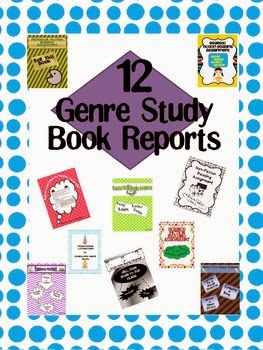
http://www.teacherspayteachers.com/Product/12-Different-Genre-Focused-Book-Reports-467917
Blogger: 2 Peas and a Dog Blog

This product will add spice your reading program. No more boring book reports! Students will have a choice of what to read and guidance on how to choose the right book in a specific genre.


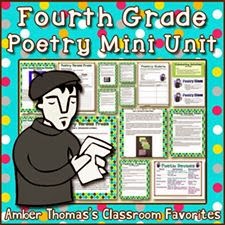
http://www.teacherspayteachers.com/Product/Poetry-Mini-Unit-Fourth-Grade-Test-Prep-229925

Blogger: Amber Thomas

Poetry Month is coming, but with Common Core, who has time for a whole month? In developing this unit I thought about what I learned about "Power Standards" this year in the ELA curriculum committee I serve on for my district. I asked myself, "What do my students need in order to access poetry for the test, and for later on in life?" I wouldn't be able to turn all my kiddos into amazing poets in two weeks, but this mini unit everything they need to know about poetry in fourth grade.

Now that you have let us share some of our favorite resources with you, let's get to the giveaway! Two lucky winners will each win a $25 TpT gift certificate to shop! To enter, all you need to do is:
  1.   "Like " ATUE on Facebook.
  2. Comment below on one of the featured products. You can comment one that you have and how you are using it, one that is on your wishlist, or one that you would like to add to your wishlist.
  a Rafflecopter giveaway