amanda beth online

  • Subscribe to our RSS feed.
  • Twitter
  • StumbleUpon
  • Reddit
  • Facebook
  • Digg
Showing posts with label Fourth Grade Studio. Show all posts

Sunday, 3 November 2013

Home/School Communication

Posted on 22:00 by the great khali
As I sat down today to work on report cards, I couldn't help but think about the people on the receiving end of them… The families. I am always anxious this first quarter. Did I communicate clearly with them in the days, weeks, and months leading up to these report cards? Will there be surprises or pieces of information that will come as a shock to the families? I certainly hope not… But I always have that thought in the back of my mind. Have I done enough communicating about student progress?

Today I thought I would share with you a few things I do that have been well received by parents and do help me continually keep the line of communication open between home and school.  Don't get me wrong, these do not replace the emails I send or the newsletters or the half sheets of paper that I send as reminders. These are simply systems I use to make sure that there are as few misunderstandings as possible when it comes to students' progress.  I'm sure there will be nothing new to you here, but I thought it might be a good time to hear your ideas on the subject as well!


One thing I do every day is ask my students to fill out assignment notebooks and have their parent/guardian initial it.  I make it very clear to the families that this is their child's responsibility and that parents shouldn't have to hunt this down!  By doing this daily, I can send messages home and parents can send messages to me and it is all tracked nicely in the books!  This works great and is the perfect complement to our 
travel folders.


Some of you may also have seen my post this summer about travel folders and what I put into mine.  If you are interested in checking that out, 
click here to read more!


Another thing I do is make sure any assessments I do are graded in a more "Standards Based" way--that way students and parents have a clearer picture of what is going well and what needs work.  Parents are very appreciative of the more specific information and have explained that it really helps them understand the grades as they are marked on 
our report cards.


Similarly, if I give a summative assessment, I do require that a parent/guardian sign the assessment showing me that they have, indeed seen their child's progress to this point.

When work is more formative in nature, I still want to make sure parents can see it so they know what we are working on in class and so they can help out at home if needed!  All exit slips, projects, learning activities, or other graded work goes home about every 2 weeks (more often depending on our units) in a folder where I ask families to look through the work together, then sign and return the folder.


Parents often leave me comments and sometimes leave their child encouraging words as well!  It's always fun for students to go through their work before they take it home . . . they can prepare for the questions their families might have and can show them how much they have improved even since those exit slips were given.

So . . . as I dig in to report cards, I hope I have done enough to set the stage!  Hope all of you have a great week and, if you're working on report cards too, hang in there!  I'd love to hear of how YOU keep the lines of communication open with families!

Watch for my NEW logo and name everywhere you go!  In fact...be watching closely for some pretty exciting things happening over on my blog!

Say goodbye to . . .


www.theteacherstudio.com
http://www.teacherspayteachers.com/Store/Meg-Anderson
http://pinterest.com/dmamec/
http://www.facebook.com/pages/Fourth-Grade-Studio/154102318070432
or find me on Twitter at @FourthGrStudio 
or Instagram @Fourthgradestudio


Read More
Posted in communication, Fourth Grade Studio, Meg Anderson, organization, The Teacher Studio | No comments

Monday, 21 October 2013

Solving problems or problem solving?

Posted on 01:00 by the great khali
This week I attended a four day training  (YES--4 days of sub plans!!!!) that was geared toward developing our understanding of how children learn mathematics and how to troubleshoot when they are struggling.  The content was fantastic.  The instructor was amazing.  Now my brain is absolutely churning.  Are you like that after professional development?  You wish there was one more day tacked on so you could actually PROCESS the information so you could be more ready to apply it?

The course actually took me way back to my college days where I was very involved with the university and the people working with CGI (Cognitively Guided Instruction).  If you are unfamiliar with the work of Thomas Carpenter, I highly recommend you do some reading!  In fact, a big part of the mathematical understanding elements in the CCSS are based on his research.

The piece of information wiggling around in my brain is a quotation that I wrote down from our presenter.  I'm not sure if they are HER words or the words of someone else, but they are powerful and relate to the idea that we are teaching children traditional algorithms in math WAY too soon.  I've been following a little discussion about this on Facebook, and all of these pieces have me thinking a LOT about what I believe to be true.  Ready for the quotation?  Read it a few times.  I needed to.

"A written algorithm is meant to SHOW how you think, not to TEACH you how to think."

As I sat their thinking, my light bulb went on BIG time.  I have always introduced multiple ways for students to solve problems.  I love to hear how they think about math...but when it gets right down to it, at some point I do TELL them how to do it.  There are some fantastic articles and books written about how much damage can be done when we interrupt children's thinking and "sense making" to fit their learning into what the adults feel is the right way.  How many times have you seen a student do something goofy with an algorithm that makes no sense?  Or when you ask them how they solved it they reply, "I crossed out the 1 and made it a 0."  Or they shrug and can't even START to tell you!  We really need to stop and think as we push ourselves to do more and more with students that we don't forget that how they learn is more important than getting through the workbook!  Check out a few of these problems that have been eye openers for me over the last year.  How do students need to APPLY math understanding rather than simply solve a math problem?  Sometimes I feel we are "training" them to solve problems on the paper instead of coaching them to figure things out on their own.
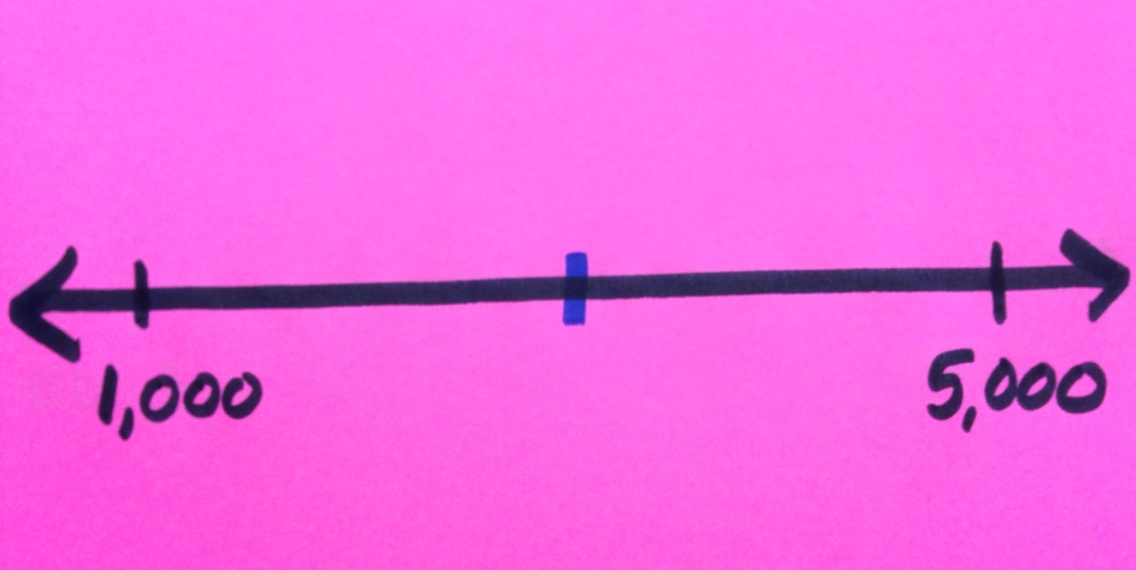
Hardly any students in my class could solve this problem accurately last spring.  Guess what they put on the blue line?  2,500.  It's halfway, right?


How about this one?  You should have SEEN the ideas my students put on their sticky notes!  What a "red flag" for me!
Or this one?  I simply asked students to "Use your ruler to divide your paper exactly in half."  Wow.

Or this one!  My students had been DRILLED with the idea that fractions are equal parts.  Where did we go wrong?

So . . . I know this is a lot of rambling, but I would love to hear your thoughts!  Do you think we are conditioning children to try to just solve the problems on the page instead of being problem solvers?  As we move into the next generation of career opportunities, don't we want students with amazing number sense and problem solving--not just students who can solve it the way we (or the book!) teach it?  This is where I absolutely LOVE the Standards for Mathematical Practice--the content should be taught through the lens of mathematical thinking.  So...now that I have gone on and on and possibly not made much sense, what do you think?  I have worked hard to incorporate more constructivist work in my classroom, but I sure have a long way to go!

The fraction examples above are actually a part of a full month-long unit I wrote when I discovered how much my students really struggled with constructing meaning about fractions.  They could solve the problems on the paper, but I quickly learned that their understanding was marginal!  Check it out if you are interested...it's full of activities to help students develop their own number sense about fractions.  I've also included one of my freebies of questioning prompts that can help YOU help THEM to help THEMSELVES!   Have a great week, everyone!


www.fourthgradestudio.blogspot.com
http://www.teacherspayteachers.com/Store/Meg-Anderson
http://pinterest.com/dmamec/
http://www.facebook.com/pages/Fourth-Grade-Studio/154102318070432
or find me on Twitter at @FourthGrStudio 
or Instagram @Fourthgradestudio


Read More
Posted in Fourth Grade Studio, math, problem solving, Standards for Mathematical Practice | No comments

Monday, 7 October 2013

Remediation Groups Made Easy!

Posted on 01:30 by the great khali
Today I thought I would share a quick "tip" that has helped me keep myself organized when planning remediation groups.  I must preface this by saying that organization and record keeping are NOT my strength...I consider myself a teacher "artist" more than teacher "organizer"--so when I find something that works for me, I like to share it in hopes that there are few other "structurally challenged" teachers out there!

It is, of course, good practice to identify students who struggle with concepts so that extra instruction (often presented in a new way or format or group size since the first way wasn't effective!).  I tend to use entrance slips and exit slips for this purpose.  I want to know exactly what my students do and don't know before we get to any type of summative assessment.


After I give the exit slips, I sort them into piles (shown criss-crossed here) so I can pull students to work on what they need.  Sometimes this is one-on-one, other times it is in small groups.  If all goes well, when it is time for the end of unit assessment, I have "caught" all the misconceptions, built stronger understanding, and they are ready to show me what they know!

Shockingly, this is not always the case, and all students do not always receive perfect scores on my summative assessments.  Don't judge.  So what do I do?  Summative means "end", right?

Nope.

I take a blank copy of the test to use as I grade them.  As I notice students not doing well, not working precisely, not explaining clearly--or whatever other things I "notice", I write their names down right on the blank test.  Like this.  (Note:  I just gave this assessment but made a "dummy" by replacing my students' names with fictitious ones).


My remediation/reteaching groups are right there ready to roll!  I know which students need what skills, and I can pull them when I have time over the next days and weeks.  The unit may be over, but the learning should not be.  

After I record their names right on the test (that way I can see the questions they missed), I mark the dates I met with them and then put a star when I feel they have "gotten" it!  I'm sure there is a better way to organize it, but this system has worked for me!


Anyway--just thought I'd share a little trick that works for me!  I am a HUGE believer in using entrance and exit slips.  If this is new to you, I have a few resources in my store that might help you get started...I put the link below.  Have a great week!

Using Entrance Slips

Using Exit Slips

The Two bundled together!


www.fourthgradestudio.blogspot.com
http://www.teacherspayteachers.com/Store/Meg-Anderson
http://pinterest.com/dmamec/
http://www.facebook.com/pages/Fourth-Grade-Studio/154102318070432
or find me on Twitter at @FourthGrStudio 
or Instagram @Fourthgradestudio

Read More
Posted in assessment, Formative Assessment, Fourth Grade Studio | No comments

Monday, 16 September 2013

Putting the Puzzle Together!

Posted on 17:54 by the great khali
I know this "team building" activity is an oldie but goodie, but if you are like me, you forget about some of the best ideas unless they are brought up fresh each year!

Every year my class and I work to create a giant class puzzle.  Each child is given a puzzle piece one of those first few days of school and their directions are simple--design the puzzle piece to represent YOU!

We brainstorm ideas about what might be on it . . .

--words
--pictures
--colors
--favorite things
--favorite activities

and more!

Before the students are allowed to CREATE, however, we have a class discussion about work quality.  We talk about using pencil first because it's easy to change.  We talk about work being the 5 "B's"!

BIG!
BRIGHT!
BOLD!
BEAUTIFUL!
BEST WORK!

(note: This becomes an anchor chart in our room that we refer to all year!)

Believe it or not, we review how to color neatly, how to make bubble letters--and all those "tricks" that will help them be more successful in all their other projects this year.

After their masterpieces are finished--it's time to put it all together!  Students are instructed to try to find a match and then come to me for "taping".  After they are a pair, they walk around together to find more pieces to join their section and so on!  We talk about the "ok" and "not ok" ways to do this and give the students sample phrases to use ("Hey!  I think yours might fit with their piece!" is sure nicer than "You don't fit!").  As more pieces join together, I keep the puzzle on the floor upside down for taping so they don't see the whole effect until we raise it up at the end!


When we finish--and before the unveiling-we have a talk about what we learned during the creation of their pieces and the assembly of the puzzle.  It's fun to see what the students come up with . . . they are often more insightful than I am!

So are YOU ready for the unveiling?  Here we go!


Isn't it great?  The puzzle hangs outside our classroom above our lockers until conferences are over, and the students LOVE to show their families!

Thanks for stopping by and hope your school year is going beautifully!


www.fourthgradestudio.blogspot.com
http://www.teacherspayteachers.com/Store/Meg-Anderson
http://pinterest.com/dmamec/
http://www.facebook.com/pages/Fourth-Grade-Studio/154102318070432
or find me on Twitter at @FourthGrStudio 
or Instagram @Fourthgradestudio


Read More
Posted in classroom community, Fourth Grade Studio | No comments

Monday, 2 September 2013

Building a Culture for Risk Taking

Posted on 01:00 by the great khali
Warning:  Ridiculously long and wordy blog post ahead.  
Proceed with caution.

As I think about today--my last day of summer--I can't help stopping to think about my incoming students.  I have the "numeric" data on all of them . . . their test scores.  Their reading level.  Their behavior needs.  Of course,  I really know very little about them that matters--what kind of a learner are they?  What do they love?  What makes them nervous?  What I also think about on this last day of summer is WHERE do I want them to be when I send them on their way to fifth grade--and how will I get them there?

One thing I know to be true is that creating a culture for learning is SO important.  Students need to believe in themselves and believe in US--that we are on their team and are going to help them succeed.  That trust factor is huge, and we need to spend some quality time developing that in the first weeks of school so that we can maximize learning time!


To help, I really like to stress with my students is the idea of being a risk taker!  As our students navigate through these upper elementary grades, you know as well as I do that they become more and more self-aware and self-conscious.  For some students, concern over looking "stupid" or making mistakes is enough to completely shut them down as learners.  At this age students are fully aware of who learns quickly and who does not, who has the latest and greatest clothes and who does not, who can make a three point shot or run fast or jump far--and who cannot.  How can we level the playing field?  We need to encourage ALL students to be active participants--even when they aren't feeling their most confident.  What can we do?

How about these!

Model risk taking!
One thing that I think we can easily do is model risk taking.  Writing in front of students, solving tricky math problems together--all while saying, "I'm not sure how this is going to turn out, but let's give it a try!"  Ever since my trip to the Dominican Republic, I start the year off by modeling writing a story about a time I took a risk and how it was such a great decision.  


Show yourself making mistakes--and how you handle it!
Ever have a student point out a spelling error you have made?  A computation error?  Have you ever made a mistake while reading aloud?  Use this as a chance to show your students that mistakes happen to everyone and that it's ok!  At the end of this post is a quote from a pretty cool fourth grader.  I had asked her to help me "test" my latest product, and it was a little out of her comfort zone.  She made a mistake (she highlighted the wrong thing) and didn't know what to do.  Her mom (a teacher and dear friend of mine!) coached her to just find a way to fix it--and she did!  She was so concerned about how it LOOKED, that she almost missed the opportunity to finish successfully!


Find safe ways for students to take risks!
The Common Core is going to ask our students to do work at a higher level than ever!  We certainly want our students to be successful--but they are going to have to push themselves in order to do so!  Working to provide students with scaffolded activities where they can safely try new things without worrying about grades.  I consistently like to give my students math problems where we don't even find the answer--problems like "Find all the numbers less than 5,000 where the 10's place is double the hundreds place and the digits add to 12."  We work for 15 minutes, talk about strategies, what was difficult, hints for others, how we organized our work and so on.  The "right answer"?  Not relevant.  Remember, students feel pressure from US to get the right answer, from their PARENTS to do well, and from their PEERS.  We have to create a safe environment for them.

Encourage students to share times when they have taken risks--and share the results!
One of the coolest experiences I had last year was when every student in my class did a powerpoint presentation to the class--for most, their first "real" presentation.  The rules?  You had to talk about your topic when it was your turn and applaud for everyone else.  A parent of one of my most cautious and reserved students told me after that he was so afraid for her--that he didn't think she could do it.  Not only did she do it--but she ROCKED it!  She was willing to talk about the experience with the class and SO many students were able to validate for her that they felt THE SAME WAY she did!  Another student shared about how nervous he was for his first swim meet--and how he didn't do well in his first race but the coach encouraged him and he did better in the second one.  The class cheered for him!  

One of my favorite fourth graders in the world--who I WISH could be in my class this year--struggles with this feeling that she needs to be the best and that she can't make mistakes...not because she isn't capable (she is SUPER capable!) but because of the pressure she feels.  I asked her today "What can teachers do to help students feel better about taking risks in class?"  Her answer?

"Make it fun.  Don't grade things because if they get a bad grade they won't believe in themselves."

Food for thought.

To help you try to do a little more with risk taking, I have a few freebies for you!  I really love using quotations in my classroom to get students thinking and talking.  I have made a set of 5 posters with "risk taking" as a theme for you if you are interested!


I also do a little something to help my students learn to take risks without fear of being wrong or being graded.  Whether it's writing their opinion about a section of a read aloud, writing their best guess as to what might happen in a science lab, trying their best guess at what a new word means, or putting their answer for a tough math problem, I like to use these little "try it" slips.  Students know they aren't graded--for that matter, you could make them anonymous!  Get students used to putting their ideas out there knowing that they won't be judged or scored.  Here is a link to my "try it" slips if you want to give it a try yourself!


Thanks for stopping by--and hope everyone had a wonderful three day weekend!  Don't forget to watch for the upcoming "Real Life Math" linky on Wednesday! 
 We'd love to have you link up!


www.fourthgradestudio.blogspot.com
http://www.teacherspayteachers.com/Store/Meg-Anderson
http://pinterest.com/dmamec/
http://www.facebook.com/pages/Fourth-Grade-Studio/154102318070432
or find me on Twitter at @FourthGrStudio 
or Instagram @Fourthgradestudio


Read More
Posted in Fourth Grade Studio, risk taking | No comments

Tuesday, 6 August 2013

Genius Hour--I Can't Wait!

Posted on 01:00 by the great khali
As I have begun dabbling more and more in the cyber world of Twitter, I have encountered a movement that piqued my interest a few months ago.  It ate away at me for a while, and I decided to investigate a little further.  After a few hours of searching and reading online, I made a commitment to trying it this year!  So--you might ask--WHAT IS IT?

If you haven't heard of the "Genius Hour " or the "Passion Project" movement, I'll try to give you the essence of it.  As you know, there are highly successful corporations who approach the workplace in an "outside of the box" sort of way.  You may know that Apple and Google are two of those companies--companies that try to create rich environments where creativity and individuality are prized and cherished.  Google instituted a program that they coined "20% time" where employees were encouraged  to work on ANY project (with some exceptions, of course) that they had an interest or passion in--and they found that some of their best and most innovative advances were made by employees during this time!

So how does this apply to teaching?

As you know, the increased focus on standards


and assessments

and data

and accountability

have led to some educators feeling like less and less time is available for the types of activities that trigger excitement and innovation in the classroom. The "Genius Hour" movement is geared toward trying to impart part of this back into the classroom!  Whether it's a true "hour" or some other period of time...the genius hour is geared toward putting some control back in students' hands and allowing them time to delve into a topic of interest to to them.  Something they are PASSIONATE about.  Something where they can practice all those authentic 21st century skills.  Something that makes a difference.

I have been unable to trace the origins of the "movement", but the book by Dan Pink entitled "Drive" is a great starting place.  Most teachers are asking students to pick a topic (with coaching), create a learning plan, and then spend a chunk of time (could be an hour a week, could be done in other ways) diving in and researching, learning, organizing, sharing--and, eventually--presenting their findings.


So . . . a student like my son might gather some resources


Start generating some research questions . . .

"What kinds of jobs are there in baseball?"

"What kinds of statistics to do they keep in baseball?"

"How much are baseball cards worth?"

"What statistics are most important when electing someone to the Baseball Hall of Fame?"

Once each student (or maybe teams) have generated a quality research question, the fun begins!  Students take ownership of their project plans, learn valuable research skills, and eventually share their new learning with their classmates. Can you IMAGINE how much potential this has?  You can make it as big of a deal or as small of a deal as you want.  You could try it once in a year or have it be a regular thing.  I have decided to give it a try--and I will be following up with it here and on my blog!  


Want to get learn more?  There are tons of blogs that are beginning to tackle this topic, but CLICK HERE for a great place to get started!  Make sure to watch for my updates--the good, the bad, and the ugly!

Bad research question:  How many bobbleheads does it take to
clutter up a teenager's bedroom?


www.fourthgradestudio.blogspot.com
http://www.teacherspayteachers.com/Store/Meg-Anderson
http://pinterest.com/dmamec/
http://www.facebook.com/pages/Fourth-Grade-Studio/154102318070432
or find me on Twitter at @FourthGrStudio 
or Instagram @Fourthgradestudio


Read More
Posted in Fourth Grade Studio, Genius Hour, Meg Anderson, research project | No comments

Tuesday, 2 July 2013

Problem Solving Doesn't Have to Mean "Word Problems"!

Posted on 01:00 by the great khali
So if you are like most teachers who have ever taught math, you know that "problem solving" is critical.  When you study the Common Core, you realize that thinking skills and problem solving are at the forefront of it.  If the CCSS are a little new for you, I challenge you to reframe your thinking a little bit . . . instead of looking to see "WHAT do I have to teach in math?", instead look to see "HOW should I be teaching math?


In my opinion, one of the best features of the Common Core State Standards is the "Standards for Mathematical Practice".  These 8 standards talk explicitly about the "how" we need to be attacking math instruction.  These standards help us think about what we need to do to help students become independent problem solvers.  I don't know about you, but when I went to school "problem solving equaled word problems".  You too?

After all my zillions (21 plus) years in the classroom, I began to redefine my definition of problem solving.  I began to think of it more in the context of the Standards for Mathematical Practice--the "skills" and behaviors students need to tackle ANY problem they encounter.  Don't get me wrong . . . I love word problems.  In fact, my stores are FULL of different problems of different types.  What I like to make sure students realize is that problem solving simply means diving into a math situation to make sense of it.  Whether this be studying a pattern . . . explaining your thinking . . . solving a word problem . . . sorting items into categories . . . or any number of math "situations"--all of them help students deepen their understanding of math--but they have to be willing to TRY!

In my math classroom, we talk about "perseverance" ALL the time.  My goal is always for students to be willing to dig in and get started . . . to work to make sense of problems and to have a "tool box" of strategies to try.  So, before you begin planning for the next school year, I challenge you think consider not only what math CONCEPTS will you be teaching--but HOW will you help your student dig in, push their thinking, and develop the tools needed to take on any problem they encounter?

I have a few things you might be interested in--and, perhaps, have seen before.  The first two are freebies that might help you as you do your planning . . . I know some teachers put my questioning prompts right on a clipboard so they keep them handy.  Sometimes I think we need to train OURSELVES as much as we need to "train" our students!  (Admit it--sometimes you are too quick to jump in and solve things for the students, right?  We don't like to see them frustrated--but believe me--letting them struggle can be the BEST thing for them!)


Math Problem Solving Rubric FREEBIE


Questioning Prompts to Help Develop Problem Solvers FREEBIE


This final resource is a paid resource . . . but if you haven't used math journals in the past or want a new "twist" on them, this resource showcases 4 of my favorite math journal "prompts" that I do to try to get students taking risks with math.  Check it out if you are interested!  In it, I introduce 4 different ways that you can shake up your math journals!

A "Starting Place" for Math Journals


I hope everyone has a fun and safe Fourth of July holiday!  It's hard to believe we are moving into July already.  Thanks for stopping by!


www.fourthgradestudio.blogspot.com
http://www.teacherspayteachers.com/Store/Meg-Anderson
http://pinterest.com/dmamec/
http://www.facebook.com/pages/Fourth-Grade-Studio/154102318070432
or find me on Twitter at @FourthGrStudio

Read More
Posted in Fourth Grade Studio, FREEBIE, math, Meg Anderson, problem solving, word problems | No comments

Tuesday, 4 June 2013

The Home Stretch...

Posted on 01:00 by the great khali
Well, some of us are VERY happy right now and some of us are HOLDING on for dear life!  As for me, I still have students until next Tuesday and I know I work very hard to do meaningful work until the end--for my own sanity!

We are involved in some super fun hands-on units including an engineering unit using K'Nex, a fantastic economics simulation called "Biz World"  (see my blog for several posts about what that involves--it is worth checking out their website!), and reflecting back on the reading and writing we have done.  It really is wonderful to see how much my fourth graders have learned and how much they have grown as people and as learners.  The end of the year is bitter sweet for me and usually involves tears!  I send my students out the door with a hug, a handshake, or a high five--and then our entire staff lines up along the sidewalk to wave goodbye as the buses pull away (90% of our students are bussed).  It is a really neat tradition we started when we opened five years ago.  I teach in a K-4 building, so once they leave the safety of my classroom--I feel like I am sending them to the "real world" never to be seen again!  It really is a grieving process for me . . .

One thing I do like to do is throw a little taste of summer into my last weeks by doing a few "end of year" activities including making my math word problems have an "end of year" flair, we do a writing project that becomes a bulletin board for my next year's students, and a few other "extras" that keep things interesting!

For me, I have one foot in this year as I mourn the departure of another group of students, but I have the other foot deep into my planning and ideas for next year!  I LOVE to start gathering my new ideas and creating my plan for next year.  There really is something unique about our profession with this beginning and ending cycle.

If you are looking for a FREEBIE checklist to organize your thoughts for the summer, check out a little "to do" list I made to keep myself organized!  From books I want to read, to units I want to plan, to supplies I need to buy--this quick and easy (and editable!) document can be used to keep all YOUR ideas in one place.

Freebie Summer To Do Checklists!

For those of your grasping at straws for some things to do, here is one of my favorite end of year products--and there are a few more in my store if you are lookin'!  My students have turned into QUITE the problem solvers, and I plan on having them work on some of these problems right up until the very end!


End of Year Word Problem Resource


I wish each and every one of you the best for your last days of school--and if you are already finished, try NOT to rub it in too much! 


www.fourthgradestudio.blogspot.com
http://www.teacherspayteachers.com/Store/Meg-Anderson
http://pinterest.com/dmamec/
http://www.facebook.com/pages/Fourth-Grade-Studio/154102318070432
or find me on Twitter at @FourthGrStudio


Read More
Posted in Fourth Grade, Fourth Grade Studio, FREEBIE, Meg Anderson, word problems | No comments

Monday, 20 May 2013

Teachers Helping Teachers--and Animals?

Posted on 21:39 by the great khali
I know what you are thinking . . . she's crazy.  Or, perhaps, you are thinking--at this time of year, my students are "animal enough" for me!  I get it!  I wanted to share with you something that has been eating away at me for a while, and I finally decided to act on it!

Two years ago, I finally convinced my husband to let us adopt a "rescue kitty" from a new organization in our community dedicated to not only saving animals, but educating people about the pet population.  I had wanted a pet for my family since we lost our other cat to cancer many years ago.  I won't tell you exactly what my husband got in the bargain--but let's just say that we have two cars AND another vehicle in our garage right now.

It did NOT take Milo long to forget he was abandoned and to believe he is king of our castle!


Milo, our furbaby, was the very first adoption from "Wish Upon a Paw", and adding a new family member has been a wonderful learning experience for me and for my older son--far more than having something to cuddle with on the couch!  We have both helped the organization by volunteering in a few different ways, and we are continually impressed with how hard these people work--and for no compensation.  They are constantly organizing fund raisers and finding ways to make every penny count so they can help more animals find their "forever homes".

Although we have helped out some, I have felt like there might be more I can do--and I came up with the idea of creating a product for my store where all the profits go to this organization.  My word problem sets have been growing in popularity, so I thought making a set of these on a "pet" theme might be fun--and I could commit to donating every penny of the profits to this organization.

This has inspired other talk in our house, and my son is now looking into planning a special baseball camp at his high school for special needs students and is eager to get more involved in the service club at school.  Who would have thought that a little furball who was abandoned, rescued, and then placed in our home could have inspired our family to start doing more for others?

So . . . I have no teaching tips today!  I simply challenge each one of you to find a way to make a difference beyond your classroom--whether it be volunteering . . . or finding a few extra pennies to donate to a cause that you value . . . or by talking to your students about "paying it forward" by doing good deeds.  As we continue to see horrific news scroll across our screens and we feel increasing pressures at home and work--we CAN continue to make the world a better place!  Interested in checking out the "Rescue Pets" problem set?  Here it is!

Rescue Pets: Word Problems for Charity!


I'd love to hear other ways you are making a difference in YOUR communities!  Share your ideas in the comments--what you are doing may inspire the rest of us to do more!  Please enjoy your last weeks of school--and make sure to check out the amazing posts that have been appearing over the last weeks here at ATUE!  


www.fourthgradestudio.blogspot.com
http://www.teacherspayteachers.com/Store/Meg-Anderson
http://pinterest.com/dmamec/
http://www.facebook.com/pages/Fourth-Grade-Studio/154102318070432
or find me on Twitter at @FourthGrStudio


Read More
Posted in Fourth Grade Studio, math, Meg Anderson | No comments

Tuesday, 7 May 2013

Perimeter Problems and Area Art!

Posted on 01:00 by the great khali
As you may have figured out, math is a true passion of mine as is finding ways to push students' thinking about math (and other things!) and put them in situations where they need to problem solve, cooperate, and persevere!

We are a few days into a mini unit on area and perimeter, and we have been doing a number of "hands on" investigations.  The CCSS states that fourth graders need to:

"Apply the area and perimeter formulas for rectangles in real world and mathematical problems."


It would be very easy to look at this and think, "Man--the area and perimeter formulas are pretty simple . . . I'll teach them those, do a few problems about carpet and grassy fields and we should be good to go!"  The simple fact is, we must remember that true understanding of mathematical concepts involves careful study, a variety of investigations, and applying new learning in a variety of ways.  Over the last week we have built shapes with one inch times, used cheese crackers to find rectangles with certain perimeters, and used grid paper to explore different perimeter and area questions.

Today I decided to ask students to apply some of the learning we have done to moderately open ended task.  Here is the task I gave them:


Students could use the open space at the bottom of the investigation sheet or sheets of grid paper to work on finding the 3 rectangles that would fit the rules.  Students busied themselves guessing and checking, sketching and figuring, and then asking someone to "prove" whether or not the rectangles they found did, indeed, fit the rules.  I walked around asking questions and having students prove to me with numbers and/or drawings that their three rectangles worked.

Some students crossed off efforts that weren't successful.  Others wrote comments like "too small" or "perimeter too large".

Things went along pretty smoothly for most, but we did have some work to improve along the way!  Two students were really struggling with the guess and check method and were having a hard time visualizing the different types of rectangles that can be made with any given perimeter.  I asked, "What do you do when you get stuck?  You've already tried a picture--now what?" and after a short pause . . .


Victory!  We want students to be able to draw from a wide range of strategies to help them get "unstuck" and that's just what happened.  Within a few minutes, the tiles magically arranged themselves into a great solution!

Another student was really struggling keeping track of perimeter as he counted.  He had learned a good strategy . . .


but he kept losing count and was getting a different answer each time.  I asked him how he thought he could better keep track so he didn't keep losing his place.  He really didn't have any ideas, so I gave him a little think time.  Eventually I asked, "What do I do when I am solving a problem that is a little tricky or has lots to remember?"  He lit up and said . . .

"You write stuff down!"

 . . . and so he did!


Success!  This simple strategy helped him see that he did, indeed, have the right answer!  He just couldn't keep track of it in his head.

So here's where it gets fun!  As a few students began to finish, I called a time out and brought the group together to explain the next steps.  (You thought we were finished, right?)  We talked about the measurement unit we just finished, and I explained to them the next step would be for them to BUILD their rectangles with 1/2 inch wide strips of paper.  We reviewed the definition of a rectangle and I asked the students to experiment a little with using the strips to build exact models of the rectangles they had just found.

They measured . . . 

and cut . . .

and arranged in rectangles!
As they built them, I reminded them to ALWAYS check their work with the ruler and lo and behold, many students were finding that their perimeters were no longer correct!  I asked them to brainstorm at their tables and finally someone noticed that they would have to overlap the corners or else it ADDED length to the sides.  It took some convincing for some students--but over time, all students were able to build their three rectangles.  Finished, right?

NO!  I am a HUGE believer in taking pride in one's work, so guess what we did?  We glued those rectangles down to make geometric art and we displayed them proudly in the hall for all to see!  Check out some of our finished work!


Add caption

I love to find ways to combine problem solving, art, hands on learning, questioning, and teamwork, and today was a blast!  One of my easily frustrated students said as he hung up his work, "This project was the perfect amount of challenge for me!"  I couldn't agree more!

I can't help but remind you that it is Teacher Appreciation Week!  Today is the first day of the big sale over at Teachers Pay Teachers, and we'd love for you to check out all the resources we have waiting for you!    Sunday's blog post right here on ATUE has one featured product from each one of us, and we know you'll love them.  We hope you have a peaceful week at school--and know that we APPRECIATE each and every one of you as you take time out of your busy day to see what we have going on!


www.fourthgradestudio.blogspot.com
http://www.teacherspayteachers.com/Store/Meg-Anderson
http://pinterest.com/dmamec/
http://www.facebook.com/pages/Fourth-Grade-Studio/154102318070432
or find me on Twitter at @FourthGrStudio

Read More
Posted in area, Fourth Grade Studio, measurement, Meg Anderson, TpT Sale | No comments
Older Posts Home
Subscribe to: Posts (Atom)

Popular Posts

  • Dream House: An Additive Area Project (3rd Grade Common Core)
    The 3rd grade Common Core standards are pushing us to reach a deeper understanding of many topics. For example, area is covered in much more...
  • Guest Post, Beyond Traditional Math: Common Core Math Can Be Rigorous AND Fun
    It is true, there ARE Common Core activities that are actually fun. In this stressful time of accountability and standardized testing, it is...
  • Teachers Helping Teachers--and Animals?
    I know what you are thinking . . . she's crazy.  Or, perhaps, you are thinking--at this time of year, my students are "animal enoug...
  • 5 Ways to Use a Hundreds Chart in the Upper Grades
    Hi there, upper elementary teachers! It's Blair from One Lesson at a Time , here to bring you some tips for using hundreds charts in the...
  • Language Arts...Fitting It All In!
    Greetings Friends! Mr. Hughes here of Created by MrHughes . I love my monthly slot here on ATUE! It is fun to share with you and learn from...
  • Motivational Quotes for State Testing {Free Posters!}
    Hi friends! It's Blair, from One Lesson at a Time . Well, it's about that time again. You know what time. Testing time. Everybody...
  • Perimeter Problems and Area Art!
    As you may have figured out, math is a true passion of mine as is finding ways to push students' thinking about math (and other things!)...
  • Easy Decimal Game: This Means War!
    Right before our February vacation, my fourth graders started decimals.  To start out, I always find it's easiest to equate decimals wit...
  • Angles, Angles Everywhere!
    Good morning! As many of you know I am a lover of anything and everything to do with an Interactive Notebook (INB) . I am here today to shar...
  • Creating Classroom Rules
    Every year I start out by talking to my fourth graders about rules.   But by fourth grade, they already know, on pa per, what classroom rule...

Categories

  • #ATUE
  • 100s Day
  • 2 Brainy Apples
  • 2 Fulbright Hugs
  • 2brainyapples
  • 2peasandadog
  • 3.nbt.1
  • 3.nf.1
  • 4.nf.1
  • 4mulaFun
  • 4th grade
  • 4th grade math
  • 5th grade
  • 5th grade math
  • 5th grade Reading Review
  • 6th grade
  • A Cat Named Haiku
  • Abstract Nouns
  • activity
  • Address Labels
  • adverbs
  • Air Fronts
  • Alexander rich last sunday
  • algebra
  • All Things Upper Elementary
  • Amber Thomas
  • Amber Thomas's Classroom Favorites
  • Amy Alvis
  • Amy Satterfield
  • and Share
  • Andrea M. Bentley
  • anglegs
  • angles
  • ANSWER method
  • AppleSlices
  • April Poetry Month
  • area
  • Artistry of Education
  • Aspire to Inspire
  • assessment
  • attributes
  • atue
  • ATUE takes on!
  • Augmented Reality
  • authentic performance tasks
  • back to school
  • Back to School Bargains
  • Back to School to do List
  • backward timing
  • Bar Modeling
  • Bar Models
  • behavior
  • Behavior Chart Template
  • Beyond Traditional Math
  • bingo
  • biographies
  • Blair Turner
  • Blockhead the story of Fibonaccie
  • Book Bloggin' Buddies
  • book blogging buddies
  • Book Clubs
  • Book Creator
  • Book Share
  • book talks
  • book trailers
  • books
  • boring
  • bucket filler
  • bucket fillers
  • bullying
  • bundle
  • caricature
  • CCS Math
  • CCSS
  • CCSS Math
  • Chapter 3
  • character traits
  • cheap present
  • Cheat Sheet Ring
  • christmas
  • circuits
  • class dojo
  • Class Themes
  • classdojo
  • Classifying Animals
  • classroom community
  • Classroom Decor
  • Classroom Game Nook
  • classroom library
  • classroom management
  • classroom organization
  • Classroom Stationery
  • Classroom Teacher Report Sheet
  • Classroom Twitter Board
  • clickers
  • close reading
  • Close Reads
  • Cloud Types
  • Co-teaching
  • Collaboration
  • collaboration cuties
  • colonies
  • Coloring Page
  • comics
  • commercials
  • Common Core
  • Common Core and So Much More
  • common core writing
  • communication
  • Competition
  • Comprehension
  • computers
  • concept mapping
  • Concrete Nouns
  • conferences
  • connect writing to reading
  • connection to math
  • constructed response
  • Constructed Response Assessments
  • cooperation
  • cooperative learning
  • Corrina Allen
  • Crafting Connections
  • Craftivity
  • Create
  • Created by MrHughes
  • Creating Classroom Rules
  • creative writing
  • creativity
  • cross-curricular
  • cross-curriculum
  • cue cards
  • cute valentines
  • Daily Dose
  • Data collection
  • Deb
  • decimal form of fractions
  • Decimal Numbers
  • decimals
  • deck of cards
  • dialogue
  • dice
  • dictionary skills
  • differentiation
  • Dinosaur Deals
  • discovering activity
  • division
  • DocsTeach
  • download
  • Earth
  • Earth Day
  • easter
  • easy
  • eBooks
  • Eclectic Educating
  • Edmodo
  • educational technology
  • educents
  • Educreations
  • ELA
  • electricity
  • elementary math
  • Elizabeth Stavis
  • emotions
  • end of the school year
  • engagement
  • engineering
  • English Language Arts
  • ESL
  • Estimating
  • Every Day Counts Math
  • every pupil response
  • Exit Slips
  • experiment
  • extended response
  • fact fluency
  • first days of school
  • five senses
  • flapjack
  • flashcards
  • flippable
  • Flipped Classrooms
  • foldable
  • Formative Assessment
  • Fourth Grade
  • Fourth Grade Studio
  • Fourth Grade Test Prep
  • fraction equivalents
  • Fraction of a set
  • fractions
  • free
  • Free for All
  • FREEBIE
  • freebies
  • Friday Free Writing
  • fun
  • Fun 4 All
  • Gabrielle Dixon
  • game
  • Games
  • GCF
  • Genius Hour
  • genre
  • geography
  • Giveaway
  • goal setting
  • Goals
  • grading versus noticing
  • Grading with Labels
  • grammar
  • GRASPS
  • greedy triangle
  • groups
  • Guest Contributor Form
  • guest post
  • Guest Poster badge
  • Guest Posters
  • Guided Reading
  • Haiku
  • hands-on
  • hands-on learning
  • Heather LeBlanc
  • Historian
  • holidays
  • How to Clean Your Desk
  • hundreds charts
  • Hunter's Teaching Tales
  • I Love My Classroom
  • idioms
  • IEP Cheat Sheet
  • If you hopped like a frog
  • INB
  • incentives
  • Independence day
  • inexpensive
  • informational texts
  • informational writing
  • integrating content
  • integration
  • Interactive Learning
  • Interactive Notebook
  • intro
  • Inverted Classrooms
  • iPad
  • iPad apps
  • iTeach 1:1
  • Jamie Riggs
  • Jennifer Findley
  • Jennifer Smith-Sloane
  • Joey Udovich
  • Journey Through the Text
  • Kate's Classroom Cafe
  • Katie Lately
  • Keith Geswein
  • Kelly Anne
  • Kimberlee Fulbright
  • kindness
  • Kristen Stull
  • Kristin Kennedy
  • Labels- Learn With Leah
  • Ladybug's Lounge
  • Language Arts
  • Last Day of School
  • LCM
  • leadership
  • Leah Fullenkamp
  • Leanne Baur
  • Leanne Baur's Creative Classroom
  • learning goals
  • learning styles
  • Lesson of a Story
  • Letters to Incoming Class
  • life science
  • line plots
  • linky
  • linky party
  • literacy
  • Literacy Center
  • literary devices
  • literature
  • literature circles
  • logic
  • Long Division
  • Looking From Third to Fourth
  • Love that Dog
  • lowest terms
  • making inferences
  • Maneuvering the Middle
  • manipulatives
  • Martin Luther King
  • Mary Bauer
  • matching
  • math
  • math and writing
  • math fact fluency
  • Math in Focus
  • math is real life
  • Math Learning Center Stations
  • math love
  • Math Manipulatives organization
  • Math MCAS Review
  • Math multistep word problems
  • Math Science Social Studies...Oh my
  • math valentines
  • math vocabulary
  • Math Workshop
  • MCAS
  • measure to the nearest quarter inch
  • measurement
  • media
  • Meg Anderson
  • Melissa Mazur
  • Melissa O'Bryan
  • Memories
  • mental health
  • mentor sentence
  • mentor text
  • Mentor Texts
  • mentoring
  • Messy Desks
  • Middle School Math Moments
  • MissMathDork
  • Mobile
  • MobyMax
  • MOOD
  • More Time 2 Teach
  • Morning Meeting
  • Morning Meeting Greeting
  • Motivation
  • Mr. Magician
  • MrHughes
  • Mrs. Thomas's Classroom Favorites
  • multiplication
  • music in the classroom
  • national archives
  • National Poetry Month
  • nerdy valentines
  • New Student Preparation
  • New Year's
  • notebooking
  • Noun Hunt
  • nouns
  • novel discussion groups
  • Number Lines
  • number of the week
  • observation
  • on-line learning tool
  • One Lesson at a Time
  • Open Response
  • opinion writing
  • Order Up!
  • organization
  • ornaments
  • parent's night
  • parents
  • partner work
  • Patriot Day
  • performance assessments
  • performance tasks
  • perimeter
  • perseverance
  • persuade
  • persuasive writing
  • pi
  • pi day
  • Pigs in the Pantry
  • pinterest
  • Plan B
  • Planner Labels
  • podcasting
  • Poetry
  • Poetry Elements
  • Poetry Unit
  • Point of View
  • positive
  • positive points
  • pre assessment
  • Precipitation
  • presents for your students
  • prime factorization
  • Printable Forms
  • Printable Packet
  • problem solving
  • professional development
  • Prose
  • punctuation
  • Puppet Pals
  • puzzles
  • Pythogoras and the rations
  • QR Code Labels
  • QR Codes
  • quadrilaterals
  • questioning
  • quotations
  • Rachael Parlett
  • RAFT writing tasks
  • read-aloud round-up
  • Reader's Theater
  • Reading
  • reading across the curriculum
  • reading across the curriculum G is for Google
  • reading resources
  • reading response
  • reading social studies integration
  • Reading Workshop
  • real world
  • real world application
  • RebeccaHallock
  • rebus
  • recording
  • Recruiting Guest Bloggers
  • rectangles
  • reference sources
  • Reflection
  • Regions
  • relays
  • remediation
  • research project
  • Response to Reading
  • Review Game
  • revision
  • Revision Tips
  • rhombus
  • Right Down the Middle
  • rigor
  • risk taking
  • rounding
  • roundup
  • Rubric Labels
  • ruler
  • Sale
  • salt dough
  • salt ornaments
  • save fred
  • school projects
  • science
  • science and writing
  • science labs
  • science notebooking
  • Science writing integration
  • Seating Charts
  • Secrets Revealed
  • Sentence Fragments
  • September 11th
  • SET
  • shearerlysadler4thgrade
  • Short Stories
  • Shut the Door and Teach
  • sight words
  • Sign Up Board
  • Singapore Math
  • snow removal
  • Social skills
  • social studies
  • social studies and writing
  • solar system
  • sorting
  • spaghetti and meatballs for all
  • Spain
  • Special Education
  • Spring Fever Sale
  • Square Numbers
  • squares
  • St. Patrick's Day
  • Standardized Testing
  • Standards for Mathematical Practice
  • standards-based
  • State Float Project
  • States
  • states and capitals
  • States and Regions Unit
  • STEM
  • storytelling
  • stressed
  • student engagement
  • student engagment
  • Student Materials Shelf
  • Student Organization
  • student portfolios
  • Students share news
  • study
  • Successful 50 Minute Classes
  • summer
  • summer learning
  • Summer Project Series
  • Summer Reads
  • Symmetry
  • synonyms
  • tabitha carro
  • take time to write
  • Tammi Booth
  • task cards
  • Teach
  • Teacher Appreciation Week
  • teachers
  • Teachers working together
  • TeachesThirdinGeorgia
  • teaching
  • Teaching Abroad
  • Teaching Books
  • teaching elementary math
  • Teaching Special Thinkers
  • Teaching To Inspire in 5th
  • team building
  • Team Planning Form
  • technology
  • TEFL
  • Ten Marks
  • test prep
  • testing
  • testing brain breaks
  • thank you
  • thankful
  • thanksgiving
  • the balanced classroom
  • The Brown Bag Teacher
  • The Peanut Gallery
  • The Teacher Studio
  • Theme
  • TheRoomMom
  • thesaurus
  • Timesavers
  • TPT
  • TpT Sale
  • Upcycling Craft Project
  • valentines
  • valentines day
  • Vertebrates
  • video
  • videos
  • Vista Print
  • vocabulary
  • Warm Ups
  • Water Cycle
  • Weather Unit
  • White Boards
  • Whole class game
  • Whst's your angle Pythagras
  • Wild About Fifth Grade
  • word problems
  • Word Search
  • Wordle
  • writers workshop
  • writing
  • writing connection
  • writing cycle
  • writing in the classroom
  • writing portfolios
  • writing projects
  • Writing Workshop
  • Yearn to Learn
  • YouTube

Blog Archive

  • ▼  2014 (62)
    • ▼  April (13)
      • Guest Post, Beyond Traditional Math: Common Core ...
      • Easy Fraction of a Set Game
      • Introducing Division Concepts
      • Testing Time is Upon Us!
      • Fun, Quick, and Easy Reading Comprehension Games f...
      • Guest Post: Kimberlee Fulbright, Close Reading J...
      • I Have... Who has.... {Freebie + Giveaway!}
      • Number Line Frustration? Walk the Walk!
      • Creating polygons in the classroom
      • Bringing Earth Day into the Classroom
      • Guest Post Lucy Ravitch: How Decimals and Fractio...
      • Test Incentives and Motivational Ideas
      • Guest Post from The Brown Bag Teacher: Augmented ...
    • ►  March (16)
    • ►  February (15)
    • ►  January (18)
  • ►  2013 (241)
    • ►  December (15)
    • ►  November (18)
    • ►  October (24)
    • ►  September (19)
    • ►  August (15)
    • ►  July (20)
    • ►  June (20)
    • ►  May (25)
    • ►  April (19)
    • ►  March (21)
    • ►  February (18)
    • ►  January (27)
Powered by Blogger.

About Me

the great khali
View my complete profile