amanda beth online

  • Subscribe to our RSS feed.
  • Twitter
  • StumbleUpon
  • Reddit
  • Facebook
  • Digg

Friday, 12 April 2013

Joining in on the FUN!!

Posted on 03:00 by the great khali
Well hello there!  I'm the newest member of ATUE, Jamie Riggs, also know as MissMathDork!


I am so incredibly excited to be joining this amazing group of collaborators in their journey to bring you awesome lessons for your kiddos.  I am currently a Math Specialist at a 5-8 middle school in Virginia.  I spend 1/2 of my day working with my 16 core math teachers and 4 special educators.  I spend the other 1/2 of my day working with 38 math resource students who are between 1 and 5 years behind in their basic math skills.  I love that my job changes every day and that it keeps me on my toes!  I also love that I get to keep my feet in the classroom!  Working to vertically align the curriculum, instruction and vocabulary is HUGE, but I LOVE being with my kiddos!
Before becoming the math specialist at my current middle school, I taught 7 years of Algebra and Geometry at the middle school level and I spent one year working with my College Alma Mater (Go Tribe!) working as a Math Specialist to schools that were struggling to make AYP (Annual Yearly Progress) in math at all levels. 

When it comes to math, I am a HUGE NERD.  I love anything and everything pi related, especially t-shirts.  I also love collecting fun earrings that are math-geek-chic (thankfully my awesome Mother-in-law helps with that obsession!)  My absolute favorite ones are my domino earrings.  


Any way, enough about my love of nerdy math attire!  How about what I'm all about - MAKING MATH FUN!  Working with teachers and kiddos at 4 different grade levels really allows me to see need for different types of activities across the board, and so, I create them!  As I was helping in classrooms around my school, I noticed the need to make measurement (both metric and customary) more exciting, so I created Measurement Wars.  AND, just this past week, I added a product called Measurement Made Easy, which is a series of posters featuring my MissMathDork avatar teaching various ways of understanding measurement. Make sure to check out my blog post on the activity - the kiddos had a BLAST and there were quite a few "ah-ha" moments!!!  


Remember how I said I teach in Virginia?  Well, if you didn't know Virginia didn't adopt the CCSS,  BUT I am very aware of all the CCSS craziness going on all around me.  Just recently my dear friend, Jennifer Smith-Sloane aka 4mulaFun and I were chatting, and she was wishing for a CCSS checklist to keep herself organized with her Solve and Snip series.  We chatted about how she wanted it to look, and possible ways teachers could use it and then I went to work. A few days later, I sent her the checklists to look over and proof.  AND NOW that we've made them what we wanted, I'm offering them to you for FREE!  There are (currently) three checklists: one for K-2, one for 3-5, and one for 6-8.  In the semi-near future I plan to create two more for the High School Common Core Math Standards.  


Get your FREE K-2 Checklist here, your FREE 3-5 Checklist here, and your FREE 6-8 Checklist here!

I would LOVE for you to download each of the CCSS checklists but DON'T FORGET

FEEDBACK = LOVE

Oh! and just because this is my first post, and it needs to be EXTRA SPECIAL... the first 3 people to leave comment with their email address in it will receive my Measurement Made Easy bundle for FREE!!

Want to stay in contact with me?  Here are some awesome options:
MMD on Facebook
TPT Store
TN Store
Blog
Pinterest
MMD requests


Read More
Posted in CCS Math, Common Core, FREEBIE, Jamie Riggs, math, measurement, MissMathDork | No comments

Wednesday, 10 April 2013

Concept Mapping

Posted on 23:00 by the great khali
I was introduced to concept mapping several years ago, but didn't really start using it my classroom until this school year.  When I was asked to be a science trainer for our district in 2011, the district wanted us to use concept mapping as a way to teach vocabulary. They wanted us to encourage our teachers to use concept mapping instead of your standard definitions to learn science vocabulary.

Since I had never used this type of mapping in my lessons, I spent quite a bit of time watching the other trainers working with the teachers and learning how to use them myself. Unfortunately, I don't think many of the other teachers in my building are using the maps, so my students don't see them until 5th grade.

This year I have tried to implement them fully into our science curriculum (I'm thinking about doing social studies next year). We start off the same each time.

After each science activity (we use the FOSS kits), the students come up with words to put on our word wall or word bank.  Each day we use a different color.

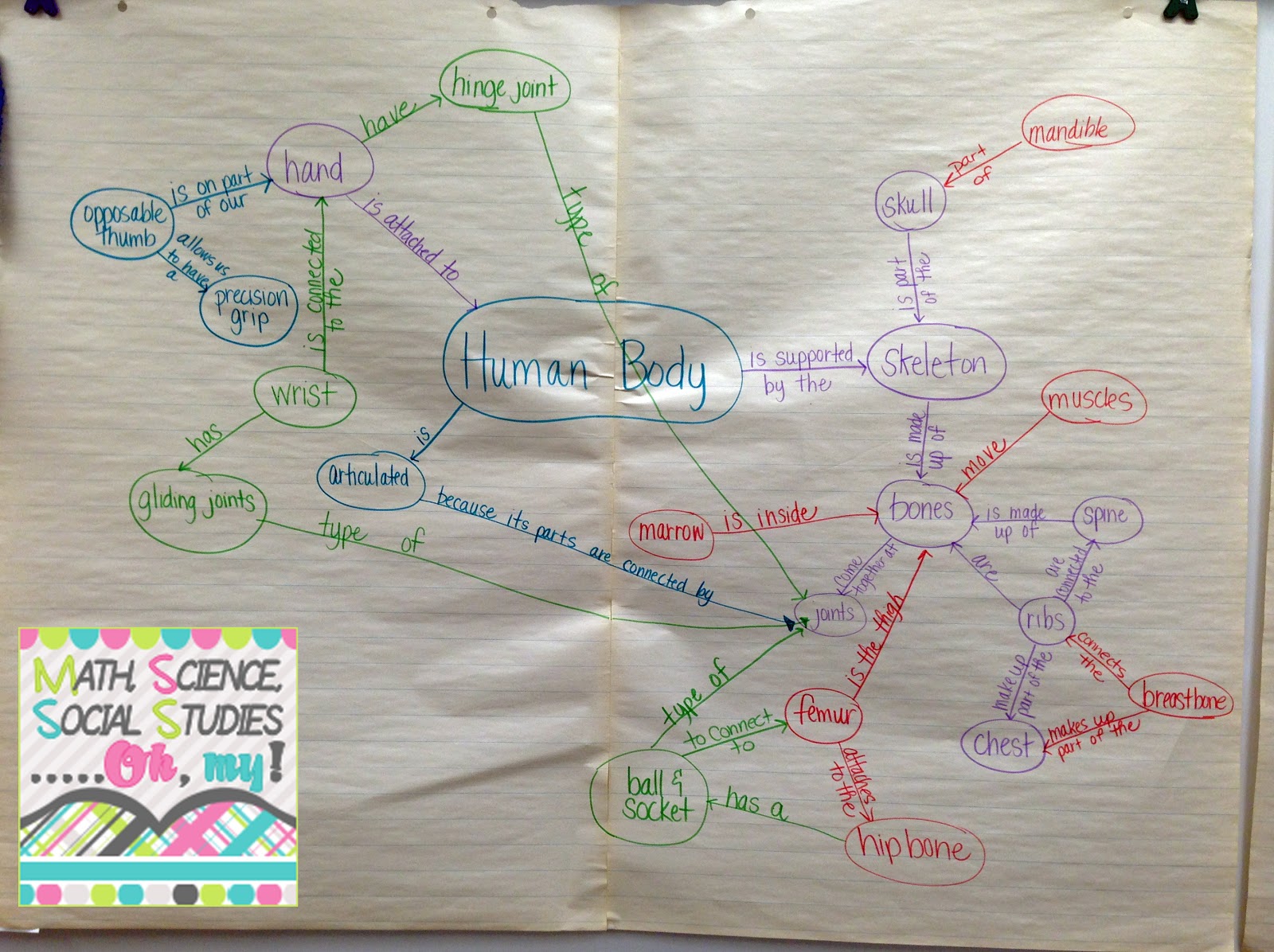
5th grade Human Body FOSS kit
After coming up with our words, we then put them on the concept map.  The hardest part for the students seems to be the wording that ties each of the words together.  I try not to lead them into what I think it should be, but to let them come up with how the words connect with each other. 

5th grade Human Body FOSS kit
Each day after we are satisfied with what we have done to the map, the students copy that part of the map into their science journals.

5th grade Food Webs and Chains FOSS kit

For more information on using concept maps in your classroom, I have listed a couple of resources:

This is an article from Stanford, Using Concept Maps in the Science Classroom, can give you a little more insight to mapping in your science class.

Science-West also has an interesting read:  Concept Mapping.

Do you use concept maps in your classroom?  We would love to hear about how you successfully implement it into your curriculum.


Visit my Blog!
Check out my TpT Store
Follow me on Pinterest


Read More
Posted in Amy Alvis, concept mapping, Math Science Social Studies...Oh my, science | No comments

Tuesday, 9 April 2013

Teaching Them How to Think By Asking the Right Questions!

Posted on 01:00 by the great khali
Hello!  I hope everyone is ready for spring!  If you are like me, you are back in the trenches after a little break and are ready to hit the ground running for the final chunk of the year.  If you follow my blog at all, you know that constructivist learning is BIG with me!  I firmly believe that our job as teachers is to watch our students, provide them with meaningful learning opportunities, and then coach them to increasingly higher levels of understanding.  This requires the careful selection of learning targets, constant formative assessment, and REALLY knowing your students--how they learn, how they DON'T learn, and what they need.

I just finished a huge month-long fraction unit with my class, and I really worked hard to get to know my students as "fraction experts".  This took time and, most importantly, it took lots and lots of questions on my part to really try to get to know my students as learners.


We drew . . . 

We sorted . . .

We critiqued . . .

We "proved" . . .

We modeled . . .

We even debated!

And what was I doing while all these things happened?  I watched.  I took notes.  I took photos (I am a very visual "rememberer"!) and I planned based on what I saw.  So what was at the root of all of this?  I truly believe that over the last 20 years of teaching, I have learned how best to QUESTION my students to get to know them as mathematicians.  I have watched the type of questions I ask evolve as I have grown as a teacher.  No longer do I ask questions that are purely related to the ANSWER such as

What did you get?

or

Did you get it right?

Instead, I try to to ask the kinds of questions that accomplish other goals.  I want to know things like--

Are they stuck?  What do they need to get "unstuck"?

Can they get started?

Can they explain what they have done?

Do they have the right strategies to solve the problem?

Do they know what tools they should be using?

How are they feeling about their status?  Are they confident?  Frustrated?

It is amazing to watch the students grow as thinkers when I do less of the work!  By putting the responsibility back on them, students must take a more active role in their own learning.  Confidence grows.  Mathematical understanding grows.  Self-sufficiency and perseverance become the norm.  So, I have a challenge for you!  Watch yourself in the next few math lessons you teach.  Try to track the kind of questions you are asking.  If you think you are in a rut or think that maybe your students aren't doing enough of the work--try printing off the list of questioning prompts I've written up for you!  See if you can incorporate more of them into your lessons and see how your students respond.  It takes time, a gentle hand, and patience with yourself!  Sometimes it's hard to relinquish control--but, boy, is it worth it!  I've included a link to the questioning prompt freebie below.  I'd love for you to check it out and let me know how it goes!


Math Questioning Prompts for Teachers FREEBIE!


I would also love for you to see this in action!  Stop by my blog and check out some of the fraction posts (there are 16!) to see how I modeled this.  If you are looking for even more guidance, I did put all 16 fraction investigations together into a giant unit available for purchase.  Reviews have been great and success stories are pouring in!  Check it out if you are interested.


Hands On Fraction Unit!

Thanks for stopping by!  I hope you have a wonderful week at school . . . it won't be long before we will be saying goodbye to this group of learners so make the most of every day!


www.fourthgradestudio.blogspot.com
http://www.teacherspayteachers.com/Store/Meg-Anderson
http://pinterest.com/dmamec/
http://www.facebook.com/pages/Fourth-Grade-Studio/154102318070432
or find me on Twitter at @FourthGrStudio


Read More
Posted in Common Core, Formative Assessment, Fourth Grade Studio, FREEBIE, math, Meg Anderson, questioning | No comments

Sunday, 7 April 2013

Getting EVERY Student Writing Poetry!

Posted on 21:00 by the great khali

Hello again friends,


I hope everyone has had a chance to enjoy some time off for spring break and is not suffering too much through state testing!  I wanted to talk today about something much more fun than standardized testing...POETRY!

I absolutely LOVE teaching and writing poetry.  It is magical for me when every student realizes that they are all poets that have something important to contribute to this word.  I am going to share the way I get all my fifth graders started writing and enjoying poetry.  Like every class, there are those students who start writing a million ideas in a million different directions.  Then there are those who have no ideas and spend 30 minutes finding anything and everything to distract themselves from attempting to write poetry because it's just not easy.

There is a way to bring both these extreme types of learners together and have everyone else in between successful as well.  The way I introduce writing poetry is to NOTICE really great poetry as readers.  We begin by exploring lots and lots of different poetry anthologies that interest students. 

 Here are the steps I take:

1. I read several different poems I enjoy to the class, sharing my thinking about each poem.  I often talk about my emotions, connections, and experiences with the text.  I also discuss the author's use of language and the way in which he/she put the words on the page.  This modeling is a critical first stage in showing students examples of what readers should be thinking about when analyzing poetry.

 Here are some of my favorite collections of poems!


2. I lay out bins of poetry books and tell students that today they are going to spend some time enjoying poetry as a reader.  I ask them to choose a book to read and then pick one poem that really stood out to them while reading and copy it into their poetry anthologies (blank bound cardstock paper).  They MUST copy it EXACTLY as it appears in the book.  This helps students think about line breaks and spacing in poetry.  They even copy any illustrations!!


 3. At the end of class I ask students to share the poem they copied with a partner. Then I have them talk about why they chose that poem.


That's it!  We repeat these steps over the course of several days until I feel students have been exposed to enough poetry that they are comfortable enough to try writing their own.  That is when we move into writing a poem about a poem.  We look back at all the poems we have copied and try to write our own that is similar to one of our favorite poems.

I have found this way to introduce poetry really fun and succesful for every student.  Plus, it gives me great insight into what types of poetry my students enjoy reading.  We keep an anchor chart of all the things we notice about poetry and add to it each day.  This chart is extremely useful when students transition into writing their own poetry.

If you would like to learn more about the process of reading, thinking about, and finally writing poetry, you can visit my TpT store, where I have a month-long Poetry and Figurative Language Unit of Study for the reading and writing workshops.  The units have identical lessons, but are broken into individual grade levels so that all 40 lessons can be attached to the grade-specific Common Core State Standards.  Click on the pictures below and you can download the FREE preview to see the first four days worth of lessons! 

ENJOY 20% off these Units of Study (April 8-9)!!  Click on the descriptions below!


 Thank you all for reading and I hope you and your students are enjoying some time exploring poetry in your classroom!

Jen

Follow me on Pinterest
Visit my TpT Store
Check out my Blog


Read More
Posted in | No comments

Friday, 5 April 2013

Hands-on, Hands-Down

Posted on 03:41 by the great khali
As a student, I remember sitting in my desk all day long. The only time we were allowed to get out of our desks was lunch, bathroom break, and recess. Pencils had to be sharpened before school, and there were no interruptions in the classroom. We used paper and pencil and nothing else. Working in groups or with a partner was unheard of because we might get off-task. It was pretty monotonous.

Fast-forward to my fourth grade year. I actually got to complete a hands-on project...at home, not at school, but it was still a hands-on project. My parents and I had the most fun with school work that I had ever had. Ever! My assignment was to build a replica of a volcano. I did this with the help of my parents, and I had a blast. I remember everything about volcanoes because of this assignment. Who knew they could be so fascinating because when we learned about them in class, they seems pretty boring sitting on the page in the textbook.

There has been so many studies about methods of teaching students over the past several years. The one study that I believe is accurate is the one that promotes hands-on learning in the classroom. Students who are afforded opportunities for hands-on learning are required to actively participate and they are "learning by doing." I believe hands-on learning also fosters a sense of independence in a student because the student takes ownership of his/her learning, thus creating the opportunity for the teacher to serve as a facilitator and guide the students.

There are some concepts that simply cannot be taught without some form of hands-on activity. For example, learning to play basketball would not be possible if you could not actively participate in a hands-on way. Sure, you could be taught the rules, procedures, and plays on paper, but you would not have a good grasp how to dribble, pass, shoot, and score without actually going to a basketball court and holding that basketball. This is the same for students. Some students cannot learn without seeing it, feeling it, or doing it.

In my language arts class, we are reading a book about the collapse of the world. Instead of simply asking the students to tell me what they would do if the world suddenly ended and they were left to survive, I had them work in collaborative groups to make a survival guide. The students loved it! Not only did the students love this activity, but I was also given another opportunity to learn more about my students. (I learn more and more everyday!) In their survival guide, they had to develop a list of items they would need to survive, sketch and explain how they would construct their shelter, develop a plan to survive the four seasons, and create a time capsule of ten items with pictures. They did a wonderful job!

Here are some of the pages of their survival guides:


The students still used paper and pencil to complete this activity, but it was completed in collaborative groups, discussed, and I completely served as a facilitator. 

Anytime I plan my lessons, I try to think back to my fourth grade volcano experience. Am I able to plan something hands-on with every lesson? No, but I do try to make those hands-on experiences meaningful for the students and ones that they will remember. I believe the best teaching is that where traditional teaching and hands-on learning work together. 

What are some examples of hands-on learning that work well with concepts you have taught? 


Read More
Posted in Andrea M. Bentley, Collaboration, English Language Arts, hands-on learning, Right Down the Middle | No comments

Wednesday, 3 April 2013

When Lessons Go Wrong: PLAN B!!!

Posted on 03:00 by the great khali

The week after vacation, as every teacher knows, is crunch time.  We know that the state test is rapidly approaching.  And we know that the pressure is ON.  As veteran teachers, the whole thing is old hat.

It's not old hat to our kids, however!

Usually my fourth graders tend to be well rested after a vacation (a benefit of teaching upper elementary kids; they don't forget about classroom expectations like the little ones).  But on Monday, mine were just not on their game. 

First, I was all excited to do an equivalent fractions activity involving stations and manipulatives and exploring different shapes and amounts of pieces that can equal one whole.  I was going to lead a discussion on patterns we notice and post photos of all their ideas and it was going to be collaborative and hands on and foster real mathematical thinking.

That is not what occurred.  At all. 

Similarly, my plan was to end the day with a fantastic board game I created that help kids practice how heating and cooling results in a solid, liquid, or gas.  I spent my vacation finding cute fonts for the game pieces, typing up directions, and looking forward to more thank yous like I got on 100s day for the fun activity that helped them practice a tricky concept until it was mastered.

Again...nope.  Most of the class was so off task that I called off the game.  I let the kids who had done focused work help me with some coloring/cutting prep, and let it for the next day.

It just confirms the fact that no matter how carefully you plan a lesson, no matter how fun you make it, and no matter how many classes it's worked for in the past, not every lesson works for every group of children.  Otherwise there would be a single curriculum that everyone uses.

So here's how I turned a day 1 disaster into a day 2 triumph!

The first problem was that the kids bicker, a lot.  Despite Morning Meeting and Responsive Classroom, and student generated rules and setting expectations for group work and reminders 5 minutes prior to starting, they still bicker. 

The second problem was that despite modeling each station, posting the model and directions on the board, and answering questions/the same question 10 times, lots of kids just did not understand concept and/or, more likely, the directions. 

So what I decided was to give them an extra day of break...from each other.  I love collaborative learning and I do lots of it.  Which is strange, because I'm an introvert.  Or maybe it's BECAUSE I'm an introvert, and it doesn't come naturally to me, so I want very much to impart the strategies I've learned in order to help other introverts in my class.  But when it's not working, there's no sense beating a dead horse.  When the concept is too hard AND they have to focus on collaborating well, it's too much for them to handle; one of those things has got to give, and today it was the collaboration.

So Tuesday I came in with...a worksheet.  I know, I know, what a horrible teacher I am.  Antiquated methods and all that.  But you know what?  They did it.  They did focused work for the period, they noticed patterns, and they enjoyed the relaxing atmosphere that coloring patterns tends to evoke. 

Once they finished the worksheet, I pulled out the manipulatives once again with a different, higher level skill to work on.  But by starting out with a coloring worksheet(you can get it free from my TPT store) with the exact same skill that didn't come to them when they were collaborating with a hands on activity, suddenly they could do it.     

I continued the theme in the afternoon.  I didn't let them play the science game in their groups.  Instead I told them they were going to "play with me."  I chose only 4 kids to get a game board, and I got one too.  I situated them so that kids could look on with those that got to play.  And then we each took turns, drew cards, read them aloud, talked about our move, practiced the good sportsmanship I was modeling, and applauded the first person who got to the finish line. 

I'd never tried a board game this way.

I liked it!

I'm absolutely using this strategy at the beginning of the year, and whenever a class has a case of the "bickers."  It really helped, and actually, the nearby kids weren't too bored.  They started saying "us," instead of "her" (the person near them playing).  They formed informal teams.  That created a much nicer atmosphere than having 5 separate groups with every man for himself, and bickering.  

Sometimes you just know:  It's time for plan B!


Amber Thomas's Classroom Favorites at TpT
My other blog:  Shut the Door and Teach

Image credit:  www.mycutegraphics.com
Read More
Posted in Amber Thomas, Amber Thomas's Classroom Favorites, Collaboration, Coloring Page, Plan B, Whole class game | No comments

Tuesday, 2 April 2013

Common Core Math - Line Plots

Posted on 13:14 by the great khali
CCSS.Math.Content.3.MD.B.4 Generate measurement data by measuring lengths using rulers marked with halves and fourths of an inch. Show the data by making a line plot, where the horizontal scale is marked off in appropriate units— whole numbers, halves, or quarters.

Well....that's pretty specific! Here's how I attacked this Common Core line plot standard with my third graders last week:

If you read my post about Bucket Filling, you may remember that I have a large collection of ribbons that students can tie onto their buckets when they've filled them up. I told my students that I needed their help taking inventory of our ribbon supply and displaying that data on a line plot. 

We started off by drawing a long, horizontal line on our papers. We then marked off 1 1/2 inch intervals (this step was more of an adventure than I'd planned on after 2 weeks of measurement work, but that's neither here nor there). We marked the resulting horizontal scale in quarter inches, starting at 6 inches (the shortest ribbon length). We labeled our scale (Length in Inches) and titled our line plots (Ribbon Lengths). 

Next, I "sprinkled" ribbons throughout the room. To make it easier for students to keep track of the ribbons they had and had not measured, I numbered each ribbon with a Sharpie. It's funny how different each class is year-to-year. This year, my kiddos are all about the "sprinkling". If I find a way to "sprinkle" the work throughout the room, they are complete rockstars. Whatever works, right?!

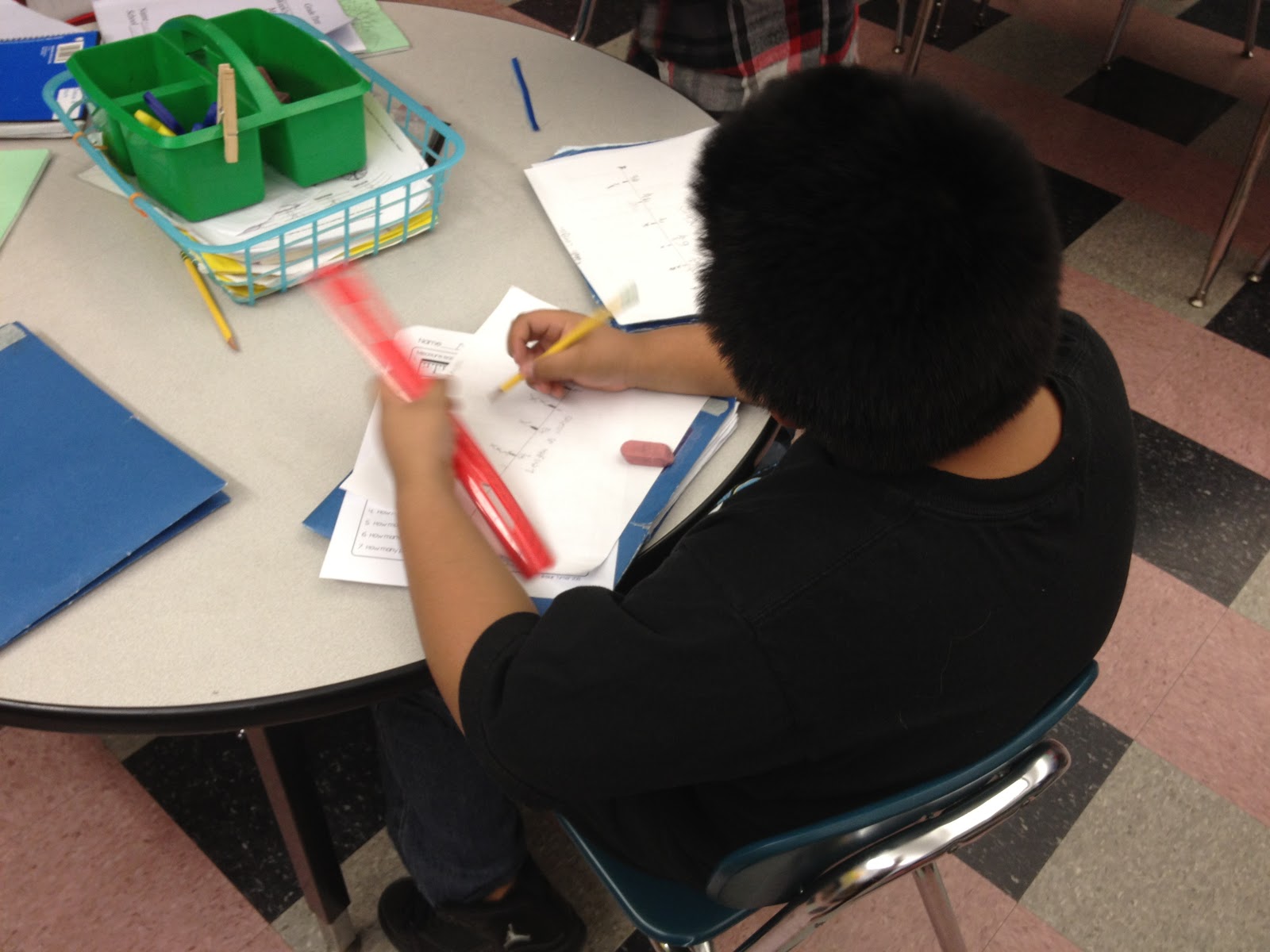
Students moved around the room, measuring the ribbons and marking them on their line plots with an "x" above the appropriate length. Here are some of my students at work:


Here's my own messy copy to give you an idea of what the finished line plot looked like:

When they were done creating their line plots, they made observations about the data in their math notebooks. Then I asked them to generate questions about their data. Some examples of what they came up with:

-How many more ribbons are 7 1/4 inches long than 6 1/4 inches long?
-How many ribbons are longer than 7 inches?
-How many ribbons are 6 1/2 inches or shorter?
-What is the most common ribbon length?

The specificity of the standard definitely was a big help in designing this lesson. It was a fun and engaging way for students to practice measuring with a ruler and creating a line plot in a more meaningful way.

If you want more measurement resources, here are two products available in my TpT store:


Click here to see my measurement riddles - a fun way to practice measuring to the nearest 1/4 inch.


Click here to see my 3rd Grade Common Core Math Assessments for Measurement and Data (includes more line plots). 


Do you have any good ideas for teaching line plots?

Keep Calm and Teach On!


Read More
Posted in Blair Turner, Common Core, line plots, math, measurement | No comments
Newer Posts Older Posts Home
Subscribe to: Posts (Atom)

Popular Posts

  • Dream House: An Additive Area Project (3rd Grade Common Core)
    The 3rd grade Common Core standards are pushing us to reach a deeper understanding of many topics. For example, area is covered in much more...
  • Guest Post, Beyond Traditional Math: Common Core Math Can Be Rigorous AND Fun
    It is true, there ARE Common Core activities that are actually fun. In this stressful time of accountability and standardized testing, it is...
  • Teachers Helping Teachers--and Animals?
    I know what you are thinking . . . she's crazy.  Or, perhaps, you are thinking--at this time of year, my students are "animal enoug...
  • 5 Ways to Use a Hundreds Chart in the Upper Grades
    Hi there, upper elementary teachers! It's Blair from One Lesson at a Time , here to bring you some tips for using hundreds charts in the...
  • Language Arts...Fitting It All In!
    Greetings Friends! Mr. Hughes here of Created by MrHughes . I love my monthly slot here on ATUE! It is fun to share with you and learn from...
  • Motivational Quotes for State Testing {Free Posters!}
    Hi friends! It's Blair, from One Lesson at a Time . Well, it's about that time again. You know what time. Testing time. Everybody...
  • Perimeter Problems and Area Art!
    As you may have figured out, math is a true passion of mine as is finding ways to push students' thinking about math (and other things!)...
  • Easy Decimal Game: This Means War!
    Right before our February vacation, my fourth graders started decimals.  To start out, I always find it's easiest to equate decimals wit...
  • Angles, Angles Everywhere!
    Good morning! As many of you know I am a lover of anything and everything to do with an Interactive Notebook (INB) . I am here today to shar...
  • Creating Classroom Rules
    Every year I start out by talking to my fourth graders about rules.   But by fourth grade, they already know, on pa per, what classroom rule...

Categories

  • #ATUE
  • 100s Day
  • 2 Brainy Apples
  • 2 Fulbright Hugs
  • 2brainyapples
  • 2peasandadog
  • 3.nbt.1
  • 3.nf.1
  • 4.nf.1
  • 4mulaFun
  • 4th grade
  • 4th grade math
  • 5th grade
  • 5th grade math
  • 5th grade Reading Review
  • 6th grade
  • A Cat Named Haiku
  • Abstract Nouns
  • activity
  • Address Labels
  • adverbs
  • Air Fronts
  • Alexander rich last sunday
  • algebra
  • All Things Upper Elementary
  • Amber Thomas
  • Amber Thomas's Classroom Favorites
  • Amy Alvis
  • Amy Satterfield
  • and Share
  • Andrea M. Bentley
  • anglegs
  • angles
  • ANSWER method
  • AppleSlices
  • April Poetry Month
  • area
  • Artistry of Education
  • Aspire to Inspire
  • assessment
  • attributes
  • atue
  • ATUE takes on!
  • Augmented Reality
  • authentic performance tasks
  • back to school
  • Back to School Bargains
  • Back to School to do List
  • backward timing
  • Bar Modeling
  • Bar Models
  • behavior
  • Behavior Chart Template
  • Beyond Traditional Math
  • bingo
  • biographies
  • Blair Turner
  • Blockhead the story of Fibonaccie
  • Book Bloggin' Buddies
  • book blogging buddies
  • Book Clubs
  • Book Creator
  • Book Share
  • book talks
  • book trailers
  • books
  • boring
  • bucket filler
  • bucket fillers
  • bullying
  • bundle
  • caricature
  • CCS Math
  • CCSS
  • CCSS Math
  • Chapter 3
  • character traits
  • cheap present
  • Cheat Sheet Ring
  • christmas
  • circuits
  • class dojo
  • Class Themes
  • classdojo
  • Classifying Animals
  • classroom community
  • Classroom Decor
  • Classroom Game Nook
  • classroom library
  • classroom management
  • classroom organization
  • Classroom Stationery
  • Classroom Teacher Report Sheet
  • Classroom Twitter Board
  • clickers
  • close reading
  • Close Reads
  • Cloud Types
  • Co-teaching
  • Collaboration
  • collaboration cuties
  • colonies
  • Coloring Page
  • comics
  • commercials
  • Common Core
  • Common Core and So Much More
  • common core writing
  • communication
  • Competition
  • Comprehension
  • computers
  • concept mapping
  • Concrete Nouns
  • conferences
  • connect writing to reading
  • connection to math
  • constructed response
  • Constructed Response Assessments
  • cooperation
  • cooperative learning
  • Corrina Allen
  • Crafting Connections
  • Craftivity
  • Create
  • Created by MrHughes
  • Creating Classroom Rules
  • creative writing
  • creativity
  • cross-curricular
  • cross-curriculum
  • cue cards
  • cute valentines
  • Daily Dose
  • Data collection
  • Deb
  • decimal form of fractions
  • Decimal Numbers
  • decimals
  • deck of cards
  • dialogue
  • dice
  • dictionary skills
  • differentiation
  • Dinosaur Deals
  • discovering activity
  • division
  • DocsTeach
  • download
  • Earth
  • Earth Day
  • easter
  • easy
  • eBooks
  • Eclectic Educating
  • Edmodo
  • educational technology
  • educents
  • Educreations
  • ELA
  • electricity
  • elementary math
  • Elizabeth Stavis
  • emotions
  • end of the school year
  • engagement
  • engineering
  • English Language Arts
  • ESL
  • Estimating
  • Every Day Counts Math
  • every pupil response
  • Exit Slips
  • experiment
  • extended response
  • fact fluency
  • first days of school
  • five senses
  • flapjack
  • flashcards
  • flippable
  • Flipped Classrooms
  • foldable
  • Formative Assessment
  • Fourth Grade
  • Fourth Grade Studio
  • Fourth Grade Test Prep
  • fraction equivalents
  • Fraction of a set
  • fractions
  • free
  • Free for All
  • FREEBIE
  • freebies
  • Friday Free Writing
  • fun
  • Fun 4 All
  • Gabrielle Dixon
  • game
  • Games
  • GCF
  • Genius Hour
  • genre
  • geography
  • Giveaway
  • goal setting
  • Goals
  • grading versus noticing
  • Grading with Labels
  • grammar
  • GRASPS
  • greedy triangle
  • groups
  • Guest Contributor Form
  • guest post
  • Guest Poster badge
  • Guest Posters
  • Guided Reading
  • Haiku
  • hands-on
  • hands-on learning
  • Heather LeBlanc
  • Historian
  • holidays
  • How to Clean Your Desk
  • hundreds charts
  • Hunter's Teaching Tales
  • I Love My Classroom
  • idioms
  • IEP Cheat Sheet
  • If you hopped like a frog
  • INB
  • incentives
  • Independence day
  • inexpensive
  • informational texts
  • informational writing
  • integrating content
  • integration
  • Interactive Learning
  • Interactive Notebook
  • intro
  • Inverted Classrooms
  • iPad
  • iPad apps
  • iTeach 1:1
  • Jamie Riggs
  • Jennifer Findley
  • Jennifer Smith-Sloane
  • Joey Udovich
  • Journey Through the Text
  • Kate's Classroom Cafe
  • Katie Lately
  • Keith Geswein
  • Kelly Anne
  • Kimberlee Fulbright
  • kindness
  • Kristen Stull
  • Kristin Kennedy
  • Labels- Learn With Leah
  • Ladybug's Lounge
  • Language Arts
  • Last Day of School
  • LCM
  • leadership
  • Leah Fullenkamp
  • Leanne Baur
  • Leanne Baur's Creative Classroom
  • learning goals
  • learning styles
  • Lesson of a Story
  • Letters to Incoming Class
  • life science
  • line plots
  • linky
  • linky party
  • literacy
  • Literacy Center
  • literary devices
  • literature
  • literature circles
  • logic
  • Long Division
  • Looking From Third to Fourth
  • Love that Dog
  • lowest terms
  • making inferences
  • Maneuvering the Middle
  • manipulatives
  • Martin Luther King
  • Mary Bauer
  • matching
  • math
  • math and writing
  • math fact fluency
  • Math in Focus
  • math is real life
  • Math Learning Center Stations
  • math love
  • Math Manipulatives organization
  • Math MCAS Review
  • Math multistep word problems
  • Math Science Social Studies...Oh my
  • math valentines
  • math vocabulary
  • Math Workshop
  • MCAS
  • measure to the nearest quarter inch
  • measurement
  • media
  • Meg Anderson
  • Melissa Mazur
  • Melissa O'Bryan
  • Memories
  • mental health
  • mentor sentence
  • mentor text
  • Mentor Texts
  • mentoring
  • Messy Desks
  • Middle School Math Moments
  • MissMathDork
  • Mobile
  • MobyMax
  • MOOD
  • More Time 2 Teach
  • Morning Meeting
  • Morning Meeting Greeting
  • Motivation
  • Mr. Magician
  • MrHughes
  • Mrs. Thomas's Classroom Favorites
  • multiplication
  • music in the classroom
  • national archives
  • National Poetry Month
  • nerdy valentines
  • New Student Preparation
  • New Year's
  • notebooking
  • Noun Hunt
  • nouns
  • novel discussion groups
  • Number Lines
  • number of the week
  • observation
  • on-line learning tool
  • One Lesson at a Time
  • Open Response
  • opinion writing
  • Order Up!
  • organization
  • ornaments
  • parent's night
  • parents
  • partner work
  • Patriot Day
  • performance assessments
  • performance tasks
  • perimeter
  • perseverance
  • persuade
  • persuasive writing
  • pi
  • pi day
  • Pigs in the Pantry
  • pinterest
  • Plan B
  • Planner Labels
  • podcasting
  • Poetry
  • Poetry Elements
  • Poetry Unit
  • Point of View
  • positive
  • positive points
  • pre assessment
  • Precipitation
  • presents for your students
  • prime factorization
  • Printable Forms
  • Printable Packet
  • problem solving
  • professional development
  • Prose
  • punctuation
  • Puppet Pals
  • puzzles
  • Pythogoras and the rations
  • QR Code Labels
  • QR Codes
  • quadrilaterals
  • questioning
  • quotations
  • Rachael Parlett
  • RAFT writing tasks
  • read-aloud round-up
  • Reader's Theater
  • Reading
  • reading across the curriculum
  • reading across the curriculum G is for Google
  • reading resources
  • reading response
  • reading social studies integration
  • Reading Workshop
  • real world
  • real world application
  • RebeccaHallock
  • rebus
  • recording
  • Recruiting Guest Bloggers
  • rectangles
  • reference sources
  • Reflection
  • Regions
  • relays
  • remediation
  • research project
  • Response to Reading
  • Review Game
  • revision
  • Revision Tips
  • rhombus
  • Right Down the Middle
  • rigor
  • risk taking
  • rounding
  • roundup
  • Rubric Labels
  • ruler
  • Sale
  • salt dough
  • salt ornaments
  • save fred
  • school projects
  • science
  • science and writing
  • science labs
  • science notebooking
  • Science writing integration
  • Seating Charts
  • Secrets Revealed
  • Sentence Fragments
  • September 11th
  • SET
  • shearerlysadler4thgrade
  • Short Stories
  • Shut the Door and Teach
  • sight words
  • Sign Up Board
  • Singapore Math
  • snow removal
  • Social skills
  • social studies
  • social studies and writing
  • solar system
  • sorting
  • spaghetti and meatballs for all
  • Spain
  • Special Education
  • Spring Fever Sale
  • Square Numbers
  • squares
  • St. Patrick's Day
  • Standardized Testing
  • Standards for Mathematical Practice
  • standards-based
  • State Float Project
  • States
  • states and capitals
  • States and Regions Unit
  • STEM
  • storytelling
  • stressed
  • student engagement
  • student engagment
  • Student Materials Shelf
  • Student Organization
  • student portfolios
  • Students share news
  • study
  • Successful 50 Minute Classes
  • summer
  • summer learning
  • Summer Project Series
  • Summer Reads
  • Symmetry
  • synonyms
  • tabitha carro
  • take time to write
  • Tammi Booth
  • task cards
  • Teach
  • Teacher Appreciation Week
  • teachers
  • Teachers working together
  • TeachesThirdinGeorgia
  • teaching
  • Teaching Abroad
  • Teaching Books
  • teaching elementary math
  • Teaching Special Thinkers
  • Teaching To Inspire in 5th
  • team building
  • Team Planning Form
  • technology
  • TEFL
  • Ten Marks
  • test prep
  • testing
  • testing brain breaks
  • thank you
  • thankful
  • thanksgiving
  • the balanced classroom
  • The Brown Bag Teacher
  • The Peanut Gallery
  • The Teacher Studio
  • Theme
  • TheRoomMom
  • thesaurus
  • Timesavers
  • TPT
  • TpT Sale
  • Upcycling Craft Project
  • valentines
  • valentines day
  • Vertebrates
  • video
  • videos
  • Vista Print
  • vocabulary
  • Warm Ups
  • Water Cycle
  • Weather Unit
  • White Boards
  • Whole class game
  • Whst's your angle Pythagras
  • Wild About Fifth Grade
  • word problems
  • Word Search
  • Wordle
  • writers workshop
  • writing
  • writing connection
  • writing cycle
  • writing in the classroom
  • writing portfolios
  • writing projects
  • Writing Workshop
  • Yearn to Learn
  • YouTube

Blog Archive

  • ▼  2014 (62)
    • ▼  April (13)
      • Guest Post, Beyond Traditional Math: Common Core ...
      • Easy Fraction of a Set Game
      • Introducing Division Concepts
      • Testing Time is Upon Us!
      • Fun, Quick, and Easy Reading Comprehension Games f...
      • Guest Post: Kimberlee Fulbright, Close Reading J...
      • I Have... Who has.... {Freebie + Giveaway!}
      • Number Line Frustration? Walk the Walk!
      • Creating polygons in the classroom
      • Bringing Earth Day into the Classroom
      • Guest Post Lucy Ravitch: How Decimals and Fractio...
      • Test Incentives and Motivational Ideas
      • Guest Post from The Brown Bag Teacher: Augmented ...
    • ►  March (16)
    • ►  February (15)
    • ►  January (18)
  • ►  2013 (241)
    • ►  December (15)
    • ►  November (18)
    • ►  October (24)
    • ►  September (19)
    • ►  August (15)
    • ►  July (20)
    • ►  June (20)
    • ►  May (25)
    • ►  April (19)
    • ►  March (21)
    • ►  February (18)
    • ►  January (27)
Powered by Blogger.

About Me

the great khali
View my complete profile